Pre-Raphaelites: Art and Poetry - major exhibition to open at Laing Art Gallery in October 2026
Pre-Raphaelites: Art and Poetry, at Newcastle's Laing Art Gallery from 17 October 2026 – 13 February 2027
Innovative Newcastle exhibition explores the connections between Pre-Raphaelite art and poetry for the first time.
Though they are synonymous with taking inspiration from medieval and early Renaissance visual art, the Pre-Raphaelites were also hugely influenced by literature, ranging from Dante Aligheri (1265-1321) and Geoffrey Chaucer (c.1343-1400) to John Keats (1795-1821) and that giant of Victorian poetry, Alfred, Lord Tennyson (1809-1892).
Uniquely exploring these connections between Pre-Raphaelite art and poetry, this major exhibition at the Laing Art Gallery will feature over 100 masterpiece paintings, drawings and objects by luminaries of the movement (founded in 1848) by artists such as William Holman Hunt (1827-1910), John Everett Millais (1829-1896), Edward Burne-Jones (1833-1898), Arthur Hughes (1832-1915), and the influential poet-painter Dante Gabriel Rossetti (1828-1882) and poet and designer William Morris (1834-1896).
Important emphasis on contemporary female artists and poets including Elizabeth Siddall (1829-1862), Kate Bunce (1856-1927), and Julia Margaret Cameron (1815-1879) is a key aspect of this extraordinary show.
Among the star exhibits will be Laing’s own Isabella and the Pot of Basil (1867) by Hunt and Burne-Jones’s Laus Veneris (1873-8), which will be given fresh interpretations in relation to their poetic subject matter.
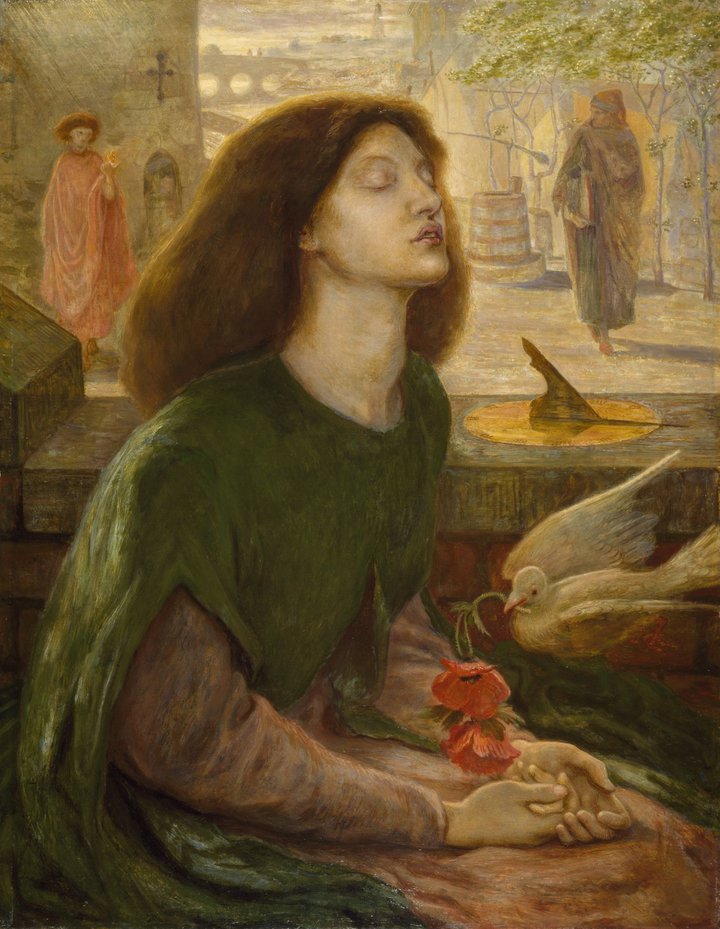
With key loans travelling to the North East from public and private collections across the UK, institutions including Tate, V&A, Birmingham Museum & Art Gallery, Guildhall Art Gallery, William Morris Gallery, Ashmolean Museum, Fitzwilliam Museum, The Higgins Bedford, the Society of Antiquaries of London, Tullie and The Bodleian, Pre-Raphaelites: Art and Poetry presents a rare opportunity to see a wide variety of significant works, not least The Woodman’s Daughter (1851) by John Everett Millais from the Guildhall Art Gallery, Beata Beatrix (1877) by Dante Gabriel Rossetti from Birmingham Museum & Art Gallery and The Forest tapestry (1887) made by Morris & Co. from the V&A.
The loans are supported by the Weston Loan Programme with Art Fund. Created by the Garfield Weston Foundation and Art Fund, the Weston Loan Programme is the first ever UK-wide funding scheme to enable smaller and local authority museums to borrow works of art and artefacts from national collections.
Pre-Raphaelites: Art and Poetry will follow three distinct themes; Poems Past, Romantic Rhymes and Victorian Visions.
The show opens with a section exploring the importance of poetry within Pre-Raphaelitism. Here visitors will be able to see a copy of the Pre-Raphaelite Brotherhood’s own illustrated publication, The Germ (also titled Art and Poetry), in which they published their own poetry and prose alongside close associates including the poet, Christina Rossetti (1830-1894). Also on display in this first room is a selection of paintings relating to the movement’s beginnings, including Ford Madox Brown’s The Seeds and Fruits of English Poetry (The Ashmolean, University of Oxford) and William Holman Hunt’s Flight of Madeline and Porphyro during the Drunkenness attending the Revelry (Guildhall Art Gallery), a picture made in response to a poem by John Keats. Henry Wallis’s Death of Chatterton (Birmingham Museum and Art Gallery), meanwhile, presents an iconic Victorian view of the tragic death of the poverty-stricken Romantic poet, while John Everett Millais’s fresh and vibrant Woodman’s Daughter (Guildhall Art Gallery) reveals how the Pre-Raphaelites engaged with the poetry of their own time.
The connection between visual art and poetry is developed in Poems Past. Here we explore how the Pre-Raphaelites engaged with early literature as subject matter for visual works, from the poetry of the classical world to 16th century works by writers such as William Shakespeare (1564-1616). This section includes a grouping of artworks that each relate in some way to the medieval Italian writer Dante Alighieri (1265-1321), who strongly influenced his namesake Dante Gabriel Rossetti. Rossetti’s watercolour Paulo and Francesca (1862, Higgins Bedford), commissioned by the Newcastle lead manufacturer and Pre-Raphaelite patron James Leathart (18220-1895), relates to Dante’s Inferno. Further Rossetti works exploring Dante’s writings include Dantis Amor (1860, Tate) and his renowned composition Beata Beatrix (1877, Birmingham Museum and Art Gallery), while a photograph by Julia Margaret Cameron entitled Lady Elcho According to Dante (1865, The Bodleian Libraries, University of Oxford) reveals a different interpretation of the idea of the Dantesque. Rossetti’s Aurelia (Fazio’s Mistress) (1863-73, Tate) reveals further connections between medieval Italian poetry and his contemporary painting practice.
Poems Past also draws attention to the strong influence Chaucer (1343-1400) had on Burne-Jones, Morris and the influential book illustrator and designer, Walter Crane (1845-1915), with a group of objects demonstrating how Chaucer’s poetic dream-vision The Legend of Good Women (1387) inspired stained glass, ceramic tiles, a watercolour, a wallpaper design and – in the Kelmscott Chaucer – one of the most beautiful books ever made (loans from the William Morris Gallery, the V&A, Williamson Art Gallery and Museum and the Bodleian Libraries, University of Oxford). A key poem attributed to King James I of Scotland (1394-1437), The Kingis Quair, which inspired works by the Newcastle-based friend of the Pre-Raphaelites, William Bell Scott (1811-1890), is also represented by loans from the National Galleries of Scotland.
The second thematic section, Romantic Rhymes presents works inspired by 17th-century poetry before revealing the great importance of the ‘Romantic’ period (late 1700s to mid-1800s) on Pre-Raphaelitism. One of the figures in this display, is the great Scots poet, Robert Burns (1759-1796), who worked on the cusp of Romanticism. Another central figure is John Keats; Keats’s poems proved a favourite subject for Pre-Raphaelite paintings at the movement’s beginning and in later decades. William Holman Hunt’s Isabella and the Pot of Basil (1867) will be brought together with both Hunt’s preparatory studies for the picture (The Ashmolean, University of Oxford) and other versions of the ‘Isabella’ subject. The studies – delicate drawings on small sheets of paper - provide insight into how Hunt developed the picture, which he painted in Florence.
The exhibition concludes with Victorian Visions, which looks at how the Pre-Raphaelites engaged with the poetry of their own time. It is the largest section, reflecting the importance of this literary form to the artists. Here we see how artists found inspiration in the poetry of Elizabeth Barrett Browning (1806-1861), Robert Browning (1812-1889) and the celebrated Pre-Raphaelite poet, Christina Rossetti (1830-1894), whose poem Goblin Market and book Sing-Song: A Nursery Rhyme Book both figure in the exhibition. Her brother, Dante Gabriel, also wrote poems that inspired new visual works by fellow artists; for example, Kate Bunce’s picture The Keepsake (c.1895-1905, Birmingham Museum & Art Gallery) interprets one of his poems.
It was Tennyson, though, whose poetry inspired the most Pre-Raphaelite art. From Hunt, Millais and Rossetti’s contributions to a now-famous illustrated edition of his poems (known as the Moxon Tennyson, 1857) to Elizabeth Siddall’s exquisite pen and ink drawings and the dreamlike photographs of Julia Margaret Cameron, the exhibition discovers how Tennyson’s verses chimed with Pre-Raphaelitism through loans from institutions including the Fitzwilliam Museum, National Galleries of Scotland, Tate, Tullie and the V&A.
We also find Burne-Jones’s Laus Veneris – related to Algernon Charles Swinburne’s (1837-1909) dramatic and lyrical poem of the same title – in this area of the exhibition. In the scene’s richly painted interior we can see tapestries, an essential art form for both Burne-Jones and Morris during the later phase of Pre-Raphaelitism. Here, visitors can experience one of the most celebrated Morris & Co. tapestries, The Forest, from the V&A collection, in which a peacock, a hare, a lion and a fox are entwined with the greenery and flowers of a forest floor. The tapestry also includes a poem written by Morris, embroidered into its design; directly conjoining art with poetry. Laus Veneris will be shown alongside three preparatory studies for the final painting, a rare medieval manuscript that may have partly inspired it, and numerous other works that together build a literary interpretation of this complex Pre-Raphaelite masterpiece.
Dante Gabriel Rossetti, like Morris, also wrote poems to directly accompany his visual works of art, and examples in the show powerfully demonstrate how the combination of poem and painting can provide different responses to the same idea, to form a ‘double work of art’. This is most beautifully realized by Rossetti’s chalk drawing Prosperine (Private Collection), on which one of his own sonnets is inscribed.
Seeking to give a wider context and visually demonstrate the interconnections between fine and decorative art and the written word through innovative arrangements, the exhibition explains how this relationship endured and evolved throughout the Victorian era. Indeed, fine and decorative art was interwoven throughout this period, with many artists working in a range of media using the same poetic sources to inspire their work. As a result, embroidery, metalwork, stained glass, tapestry, illuminated manuscripts and books in addition to paintings, drawings, prints and photographs are showcased in this rich show, with often overlooked designers such as Fanny Bunn (1871-1950) and Phoebe Anna Traquair (1852-1936) now given much-deserved, fresh attention.
Julie Milne, Chief Curator of Art Galleries says:
"Art and poetry have always been closely entwined, inspiring the creation of two of the most important paintings in the Laing Art Gallery’s collection. For the first time this unique exhibition brings together these works and other key Pre-Raphaelite paintings and decorative arts from UK wide collections. Through set piece arrangements the exhibition will explore this enriching connection which we hope will prove to be both insightful and thought provoking."
Sophia Weston, Deputy Chair of the Garfield Weston Foundation, said:
"The Weston Loan Programme with Art Fund, currently celebrating its tenth year, empowers regional organisations to bring outstanding art to local audiences. This exhibition in Newcastle, which brings a new perspective to the celebrated work of the Pre-Raphaelites, is a great example of the kind of ambitious project we want to support."
The exhibition will be accompanied by a catalogue published by the Laing Art Gallery, supported by the Paul Mellon Centre for Studies in British Art.
We gratefully acknowledge the financial support of the Cosman Keller Trust in the realisation of this exhibition.
Pre-Raphaelites: Art and Poetry is on display at the Laing Art Gallery, Newcastle upon Tyne, from Saturday 17 October 2026 - Saturday 13 February 2027. Admission charges apply for this exhibition.