The face of a movement
Elizabeth Siddall became one of the most recognisable faces in Victorian art. She famously modelled for paintings based on works by William Shakespeare and Dante Alighieri. In recent decades, research into the life and work of Pre-Raphaelite muse Elizabeth Siddall (1829-1862) has begun to recontextualise her story. No longer defined solely by her striking beauty and tragic love affair with Dante Gabriel Rossetti, she is now recognised as a gifted Pre-Raphaelite painter-poet in her own right; an artist with equal (and some say superior) genius and talent as that of her husband.
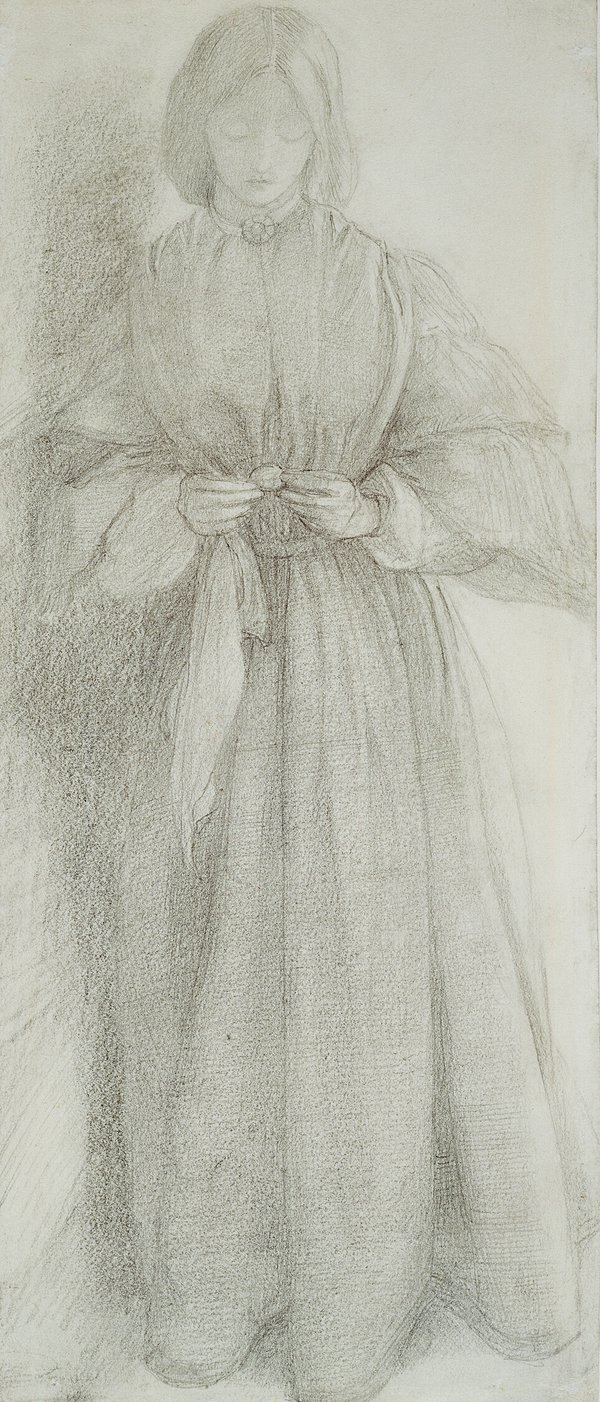 Dante Gabriel Rossetti, Elizabeth Siddal (Mrs. Dante Gabriel Rossetti), c. 1854, The Art Institute of Chicago
Elizabeth Siddall was born to a working-class family in London. In 1849 she was working as a millinery assistant. It is generally thought that artist Walter Deverell ‘discovered’ Siddall when he visited her place of work with his mother, that he employed her as a model and introduced her to the Pre-Raphaelite artists. A more recent interpretation, however, suggests that she played a much more active role in her induction into the art world when she approached William Allingham, Secretary of the Government School of Design (later the Royal College of Art), to show him examples of her art. In turn, he introduced her to his son, Deverell.
Perhaps most famous for modelling as Ophelia in John Everett Millais’s painting of the same name, Siddall’s appearance redefined beauty standards for the Pre-Raphaelite movement. With her flowing red hair, strong facial features and melancholy grace, she became one of the most recognisable of the Pre-Raphaelite ‘stunners’. Her contribution to the Pre-Raphaelite movement was far more significant than just her striking physical appearance though.
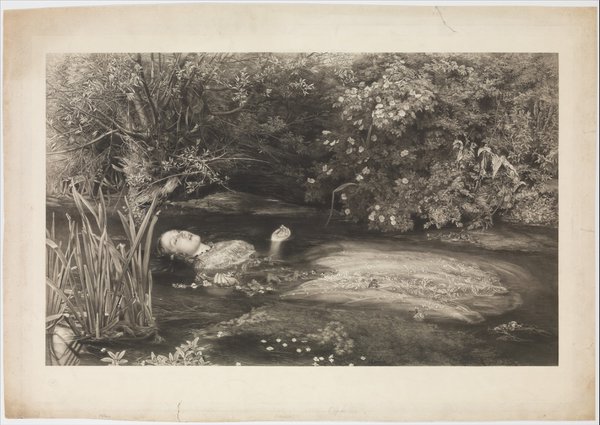 James Stephenson after John Everett Millais, Ophelia (Shakespeare, Hamlet, Act 4, Scene 7), 1866, The Metropolitan Museum of Art, New York: The Elisha Whittelsey Collection, The Elisha Whittelsey Fund, 1949
Taking the initiative
Due to the gender expectations of Victorian society, women were able to pursue artistic hobbies but were rarely able to pursue artistic careers. Many of the successful female artists were only able to pursue their career because of their links to, and relationships with, male artists. Although it was not impossible for a woman to receive a formal art education at this time, it was extremely rare. Many schools, such as the Royal Academy schools, refused to accept female students. By modelling for established artists, aspiring female artists were able to align themselves with artistic movements, giving themselves access to a studio and the best chance of studying, learning and professionally practicing art. It therefore seems quite possible that Siddall took an active role in establishing herself within the Pre-Raphaelite movement. Once she joined the artistic circle, she was in a better position to pursue her career as an artist. This course of action came with risks though; it often led society to question a woman’s morality and reputation. The risk seemed to pay off for Siddall, who was the only female artist to exhibit work in the Pre-Raphaelite’s first exhibition, at No. 4 Russell Place (1857).
A Natural Talent
For years, Siddall and Rossetti shared an art studio in London’s Blackfriars. It is said Siddall became Rossetti’s pupil, but more recent interpretations suggest that the relationship was far more symbiotic. Much like the wider Pre-Raphaelite movement, it was characterised by mutual inspiration and collaboration. After Siddall’s death, Rossetti embarked upon a project to gather and photograph as many of her works as possible. He created bound volumes with these images, one of which he kept himself. Some of his works from this period bear resemblance to Siddall’s documented works, perhaps suggesting that even after her death he continued to be inspired by her work, echoing elements of her subject matter and composition.
From the introduction of the Pre-Raphaelite Brotherhood in 1848, the members rebelled against traditional art education. In their original set of aims, created upon the establishment of the movement, they stated their intention ‘to sympathise with what is direct and serious and heartfelt in previous art, to the exclusion of what is conventional and self-parading and learned by rote’ (a criticism of the traditional teaching methods of London’s Royal Academy).2 Siddall was largely self-taught, and it was precisely because she lacked formal art training that she was considered such a natural talent. Her personal study of medieval manuscripts led to an unconventional perspective and figuration in her stylised drawings. Her work focussed more on emotional expression than anatomical accuracy. Her self-taught style became a beacon of everything the Pre-Raphaelite’s stood for, and inspired works by Rossetti in a similar style.
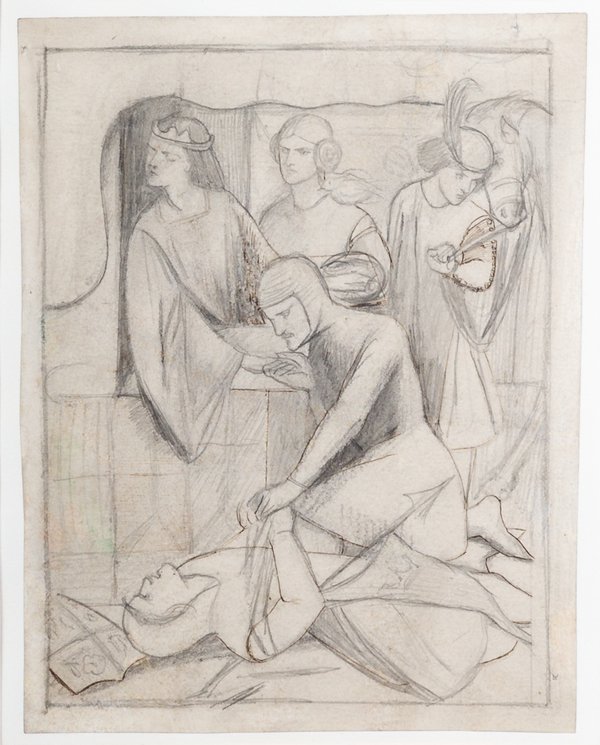 Elizabeth Siddall, The Woeful Victory, 1860, Trustees of The Cecil Higgins Art Gallery (The Higgins Bedford).
Art critic John Ruskin favoured Siddall’s stylistic drawings and considered her more talented than her husband, Rossetti. From 1855-57, Ruskin became Siddall’s patron, paying her £150 per year for all the works she produced. Rossetti himself acknowledged that when it came to ‘fecundity of invention and facility', Siddall’s skills ‘are quite wonderful, much greater than mine’.
Siddall was an avid reader, and her work was often inspired by literary sources. She seems to have been a particular fan of Alfred Lord Tennyson and, like other Pre-Raphaelite artists, created several works based on his poetry including ‘Lady Clare’, ‘The Lady of Shalott’ and ‘St Agnes’ Eve’. A commonly known anecdote refers to Siddall’s chance discovery of Tennyson’s poetry on a piece of paper that had been used to wrap a pat of butter.
Siddall’s Legacy
Although Siddall’s story has often been told in relation to the men in her life: Deverell’s Viola, Millais’s Ophelia and Rossetti’s neglected muse, it is now clear that her role in the Pre-Raphaelite movement was far more pro-active than originally recognised.
Sadly, her life ended prematurely when, at the age of 32, she died from an overdose of laudanum which she had been taking to ease chronic pain. We can only imagine how her artistic and literary careers would have progressed had she lived longer. Her enduring legacy can be explored, not only through the portraits others painted of her, but through her own poetry and remaining artworks, some of which can be found in public collections such as The Ashmolean Museum, The Fitzwilliam Museum, The National Trust, and Tate Gallery.
/https://s3-eu-west-1.amazonaws.com/atwam-images-files/production/images/content/twmuseums/2026-10/1165347.jpg "A drawing of a woman wearing a long dress, reclining outside on grass. She holds a parasol to shield her face and her bonnet rests at her feet.") Dante Gabriel Rossetti, Portrait of Elizabeth Siddal Resting, Holding a Parasol, about 1852–1855.
Dante Gabriel Rossetti, Portrait of Elizabeth Siddal Resting, Holding a Parasol, about 1852–1855.

/https://s3-eu-west-1.amazonaws.com/atwam-images-files/production/images/content/twmuseums/2026-10/1165343.jpg)
/https://s3-eu-west-1.amazonaws.com/atwam-images-files/production/images/content/twmuseums/2026-10/1165345.jpg)
:watermark(https://www.northeastmuseums.org.uk/text-image-gen/Digital+image+courtesy+of+Gettys+Open+Content+Program,0,0,0)/https://s3-eu-west-1.amazonaws.com/atwam-images-files/production/images/content/twmuseums/2026-10/1165347.jpg)