‘Double Sisterhood’
Christina Rossetti was a member of the wildly talented Rossetti family, known for their creative genius. Gabriele (1783-1854), the head of the family, was a poet and freedom fighter who was exiled from Naples to Malta, before taking up a teaching post at King’s College London. He lived in London with his wife, born Frances Polidori (1800-1886), who as a scholar and educator took an active role in the education of her daughters. Their eldest child, Maria (1827-1876), became an author. Their two sons, painter-poet Dante Gabriel (1828-1882) and writer and critic William Michael (1829-1919), were two of the seven founding members of the Pre-Raphaelite Brotherhood. Christina herself was one of the most highly regarded poets of the Victorian period; with her poems remaining popular today.
/https://s3-eu-west-1.amazonaws.com/atwam-images-files/production/images/content/twmuseums/2026-10/1165273.jpg "A black and white photograph of Dante Gabriel, Christina, Frances and William Rossetti positioned at the base of an outdoor staircase.") Lewis Carroll, Dante Gabriel Rossetti, Christina Rossetti, Mrs Rossetti and William Michael Rossetti, 1863.
Lewis Carroll, Dante Gabriel Rossetti, Christina Rossetti, Mrs Rossetti and William Michael Rossetti, 1863.The Rossetti household was well documented as a sanctuary for academics and political dissidents. It was an intellectually stimulating environment for the Rossetti siblings, whose upbringing and education encouraged their intellect and creative talents. Their mother Frances was quoted saying: ‘I now wish that there were a little less intellect in the family, so as to allow for a little more common sense.’
Despite not being an official member of the Pre-Raphaelite Brotherhood, Christina Rossetti was heavily involved in the early Pre-Raphaelite movement. Not only did she model for significant Pre-Raphaelite paintings, such as Dante Gabriel’s The Girlhood of Mary Virgin and Ecce Ancilla Domini, but her poetry was widely published in the Brotherhood’s journal The Germ, later renamed Art and Poetry. Although her work was published anonymously, and later under a pseudonym, she was the only female writer to be published in the journal. In a letter to her brother William Michael in 1849, she jokingly described her ‘double sisterhood’, likely referring to her familial kinship with her brothers, but also her literary involvement with the Pre-Raphaelite Brotherhood.
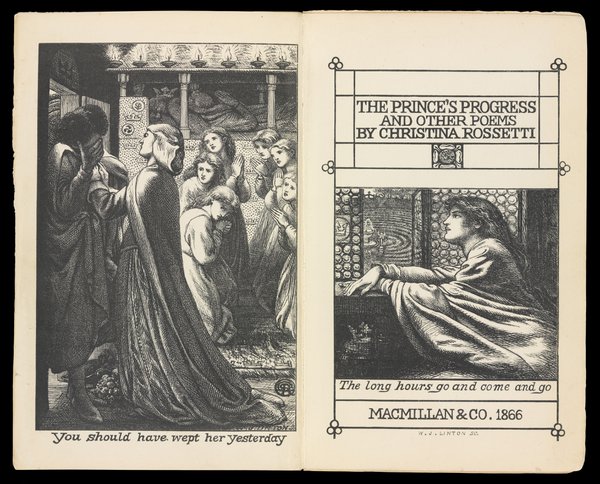 Christina Rossetti, The Prince’s Progress, and Other Poems, 1866. The Metropolitan Museum of Art, New York: Rogers Fund, 1921
The Art of the Book
The Pre-Raphaelites were famous for their inter-disciplinary skills and collaborative working practices. They were almost as active in the literary world as the world of visual art. Two of Rossetti’s most successful endeavours were Pre-Raphaelite collaborations. Her popular volume of poetry entitled Goblin Market and Other Poems contained two etchings designed by her brother Dante Gabriel, and her later publication Sing-Song, A Volume of 121 Nursery Rhymes was illustrated by Pre-Raphaelite artist Arthur Hughes. Rossetti was incredibly modest, and when sending a volume of her nursery rhymes to her brother Dante Gabriel, she included an accompanying letter in which she wrote: ‘Here is my book at last; and I hope Mr. Hughes will meet with your approval, even if you skip my text.’
As well as a writer of beautiful poetry, Christina Rossetti was celebrated as an ‘avant garde leader in the art of the book.’ The first of the early Pre-Raphaelites to publish a volume of poetry, she contributed to a revolution in book design. During the Victorian period anthologies, known as ‘gift books’, were popular Christmas presents. Publishers aimed to maximise their profits by compiling different styles of poetry and artworks into a single volume that would appeal to a variety of tastes. Rossetti felt this led to a discordant reading experience and instead favoured a consistency of style brought about by complementary text, illustration, formatting and binding which created a more harmonious experience.
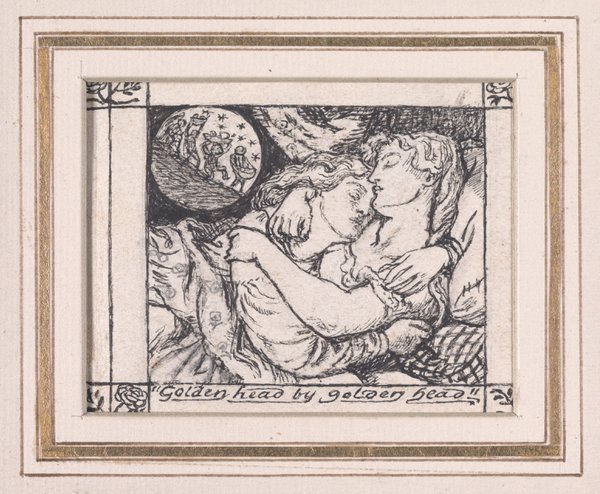 Dante Gabriel Rossetti, Golden head by golden head, for "The Goblin Market” by Christina Rossetti, 1861. The Metropolitan Museum of Art, New York: Gift of Jacqueline Loewe Fowler, 2020.
Goblin Market – A Proto-Feminist Fairy Tale
One of Rossetti’s most famous poems Goblin Market, published in 1862, is a fairy tale featuring the relationship between two sisters, Lizzie and Laura. It reads as a condemnation of Victorian gender expectations and society’s mistreatment of women.
Tempted by the luscious fruits on display, Laura decides to attend the nearby Goblin Market, despite her sister’s warning.
“No,” said Lizzie, “No, no, no;
Their offers should not charm us,
Their evil gifts would harm us."
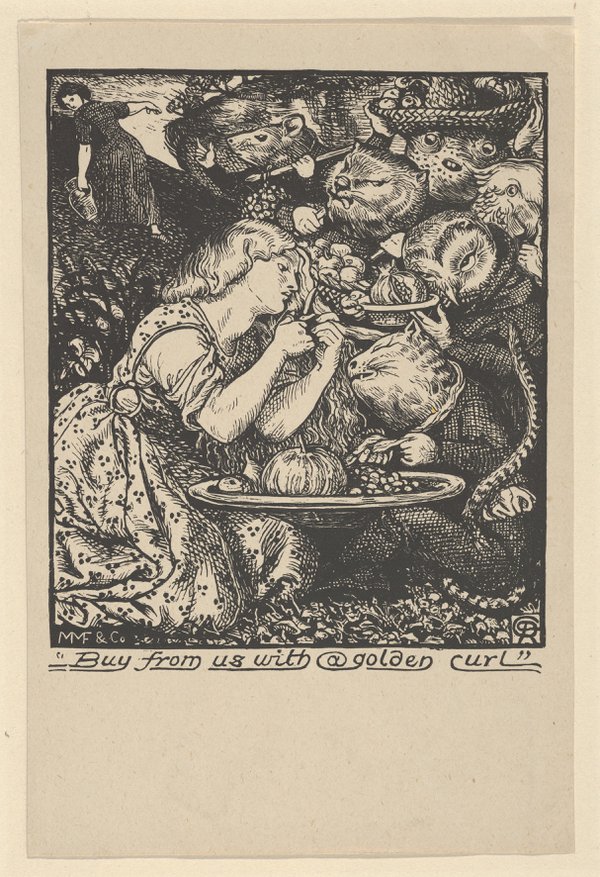 Charles Joseph Faulkner, after Dante Gabriel Rossetti, Buy from Us with a Golden Curl (frontispiece to 'Goblin Market and other Poems' by Christina Rossetti), 1862. The Metropolitan Museum of Art, New York: Gift of Walter L. Hildberg, 1937.
Laura fails to heed the warning and is seduced by the ‘goblin men’ into trading a lock of her golden hair to purchase their exotic fruit. After returning home, Laura craves more of the fruit but is unable to find the market again. She begins to waste away. Hoping to save her sister’s life, Lizzie ventures to the Goblin Market to buy more fruit. When she refuses to taste the fruit herself, Lizzie is assaulted by the goblin men who smear her face with the fruit juices.
Lashing their tails
Elbow’d and jostled her,
Claw’d with their nails,
Barking, mewing, hissing, mocking
Lizzie returns home coated in the juices which she offers to Laura, who is now disgusted by the taste. The love of her sister and gratitude for Lizzie’s bravery aid Laura’s recovery. At the conclusion of the poem Laura, now married with children, warns a group of young girls with her cautionary tale of exploitation. Laura is redeemed by her sister’s sacrifice, emphasising the importance of female relationships.
“For there is no friend like a sister
In calm or stormy weather;
To cheer one on the tedious way,
To fetch one if one goes astray,
To lift one if one totters down,
To strengthen whilst one stands.”
Goblin Market has inspired generations of women, becoming a popular subject for countless female illustrators including Kinuko Craft, whose illustrations of the tale were published in Playboy Magazine, and most recently, in 2021, Georgie McAusland.
The Victorian period is well known for strict attitudes towards the role of women in society. Rossetti’s narrative poem was unusual for the time, as it lacked any moral judgement of Laura’s bold actions. She is treated with love and compassion, and after being redeemed by her sister’s act of kindness, continues to lead a traditional life within society, as a wife and mother.
From 1859-70 Rossetti volunteered at St. Mary Magdalene’s penitentiary in Highgate. This was a house of rehabilitation for ‘fallen women’, a term that was used to refer to any woman who had experienced sex outside of marriage, no matter what the circumstances. It is thought that Rossetti’s experiences at St. Mary’s contributed to her more liberal attitude towards the role of women. It is likely that her upbringing and education had already a progressive attitude.
It is not only Rossetti’s characters who defy the traditional gender expectations of English society. The poet herself also lived an unconventional life, both professionally, and in her personal life, by choosing to remain unmarried. Although she was once engaged to Pre-Raphaelite artist James Collinson and later received a proposal from the poet Charles Bagot Cayley, her strong Anglican beliefs prevented her from marrying outside of her religion. As a published poet, her career ambitions and achievements also defied societal expectations. She joined the ranks of women artists and authors such as Elizabeth Siddall and Elizabeth Barratt-Browning, many of whom were only able to achieve a portion of the success they deserved by aligning themselves with likeminded male creatives.

:watermark(https://www.northeastmuseums.org.uk/text-image-gen/Digital+image+courtesy+of+Gettys+Open+Content+Program,0,0,0)/https://s3-eu-west-1.amazonaws.com/atwam-images-files/production/images/content/twmuseums/2026-10/1165273.jpg)
/https://s3-eu-west-1.amazonaws.com/atwam-images-files/production/images/content/twmuseums/2026-10/1165275.jpg)
/https://s3-eu-west-1.amazonaws.com/atwam-images-files/production/images/content/twmuseums/2026-10/1165277.jpg)