Every day, thousands of people cross Newcastle’s Swing Bridge. Some pause to look along the river. Most carry on without a second thought.
Yet for 150 years this remarkable structure has helped shape life on the Tyne. It carried people between Newcastle and Gateshead, opened for ships travelling to the industries upstream, and became one of the best-known landmarks on the river. Through plans, machinery, photographs, archive records and souvenirs, we can trace how an ambitious Victorian engineering project became part of everyday life on Tyneside.
Imagining the bridge
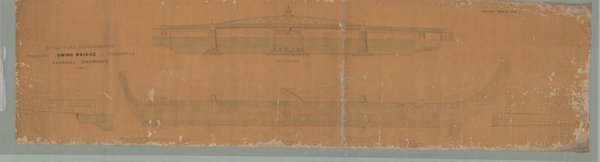 Plan and elevation of the proposed Swing Bridge at Newcastle, January 1867
The story begins not with iron or stone, but with a drawing.
Produced in 1867, this plan shows the proposed Swing Bridge before construction began. The drawing reveals the bridge’s distinctive turning span, central pier and approaches linking Newcastle and Gateshead.
Looking closely, it becomes clear that this was far more than a conventional bridge. Engineers were trying to solve a problem that had become increasingly urgent as ships using the Tyne grew larger. Newcastle needed a crossing that could carry road traffic while still allowing vessels to reach the shipyards, engineering works and industries further upstream.
The bridge was not without controversy. Contemporary reports show that the Tyne Commissioners debated whether such an ambitious project justified the cost. Supporters argued that improved access for shipping would benefit trade and industry. Critics questioned whether the expense could be justified.
Building the world's largest swing bridge
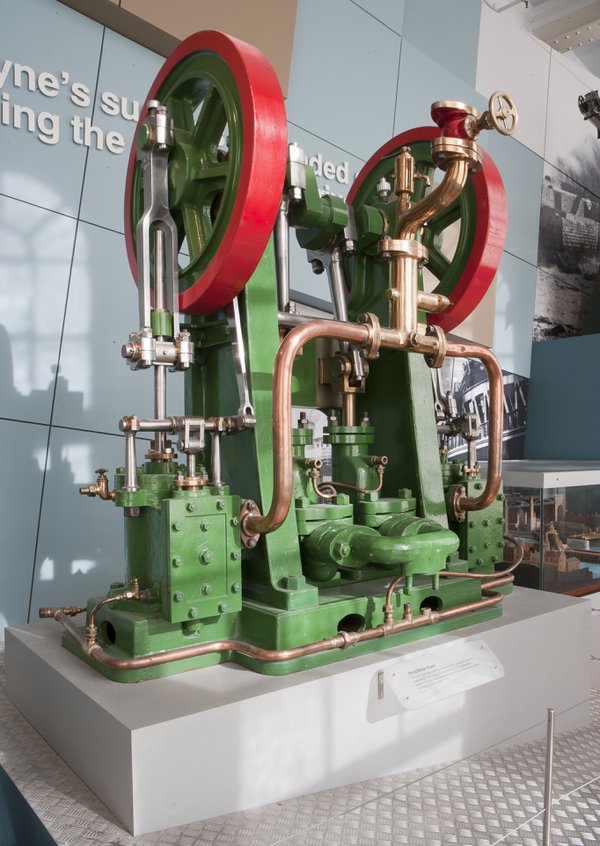 Steam pumping engine used to operate the Swing Bridge, 1876
When the bridge opened in 1876, it was regarded as a marvel of engineering.
The surviving steam pumping engine in Discovery Museum’s collection helps explain why. Built by Sir W. G. Armstrong and Company at Elswick, it generated the hydraulic power needed to move the bridge’s enormous central span.
It was an impressive achievement. The moving section of the bridge weighed around 1,500 tons, yet hydraulic machinery allowed it to rotate smoothly in about ninety seconds. To Victorian visitors, watching such a vast iron structure move across the river must have seemed extraordinary.
The engine provides a direct connection to the machinery that made the bridge possible. It reminds us that the Swing Bridge was not simply a crossing, but a machine powered by steam, water pressure and skilled engineering. Yet no amount of planning or machinery could prove the bridge would succeed. That would come when it faced its first major test on the river.
The bridge proves itself
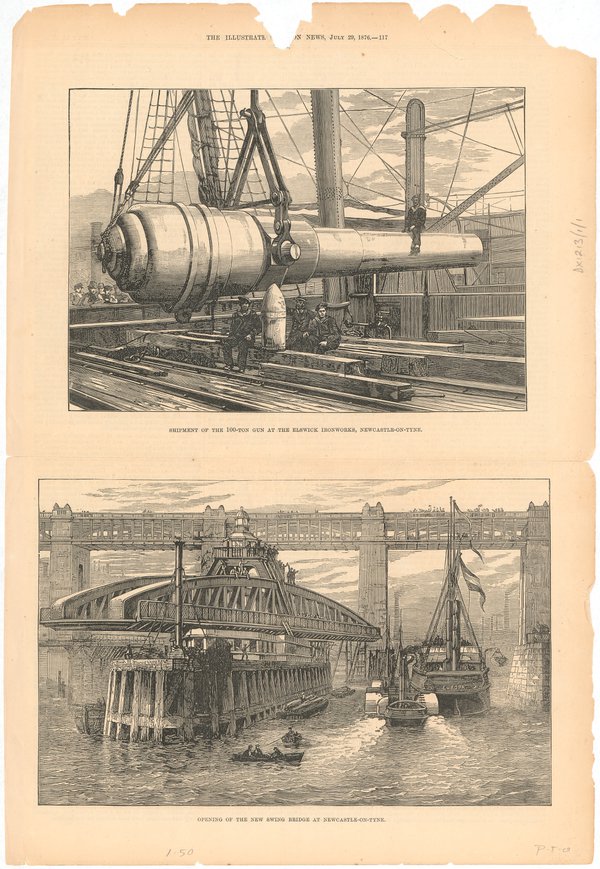 Illustrations of the opening of the new Swing Bridge and the shipment of a 100-ton gun at the Elswick Works, 29 July 1876
The bridge's most important early test came shortly after it opened.
This illustration, preserved by Tyne & Wear Archives, records one of the most celebrated moments in the bridge's history. Published in The Illustrated London News in July 1876, it depicts the opening of the new Swing Bridge and the shipment of Sir William Armstrong's famous 100-ton gun from Elswick.
The event centred on the Italian transport vessel Europa, which was travelling upriver to collect the gun for the Italian Government. Contemporary newspaper reports describe crowds gathering on the High-Level Bridge, along the Quayside and around the engine house to watch the spectacle.
Traffic was halted, the hydraulic machinery was prepared and the signal was given. The bridge's massive central span rotated smoothly open, creating a passage through which vessels could continue upstream. A coal wherry passed through first, followed by the River Tyne Commissioners' steam launch and Sir William Armstrong's steam wherry Bee. Then Europa, guided by tugs, made its way upriver to Elswick as crowds cheered from the riverbanks and bridges above.
Together, the illustration and contemporary reports capture a moment that proved exactly what the bridge had been built to do. Large vessels could now reach the industries of the upper Tyne while Newcastle and Gateshead retained a vital crossing between the two banks. Opening day was a spectacle, but the bridge's real success lay in becoming part of everyday life on a busy working river.
A working river
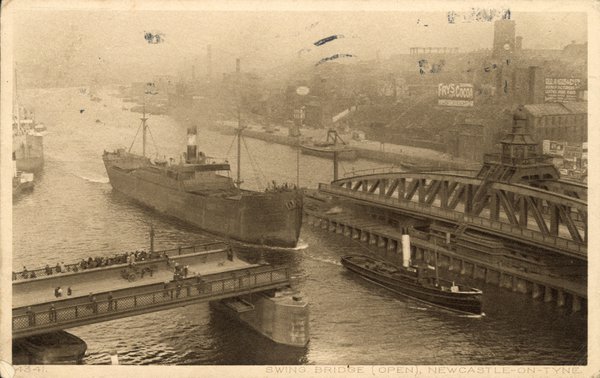 Postcard showing the Swing Bridge open with a ship being guided by a tug
This postcard captures a scene that became familiar on the Tyne. A vessel is being guided through the open bridge by a tug while people watch from the riverside. For generations of people living and working along the river, scenes like this were part of everyday life.
The archives reveal the records that helped run the bridge. The Swing Bridge Dues Cash Book (Acc148/1157) and Swing Bridge Dues Account Book No. 4 (Acc148/1158) record the collection of dues from river traffic. Alongside these are printed Directions and Regulations for the Opening of the Swing Bridge (Acc1060/925 and Acc1060/928–929), showing that the movement of ships through the bridge was carefully organised and controlled.
Behind the spectacle of the bridge swinging open lay a network of rules, record keeping and river management. Together, the postcard and archive records show how the Swing Bridge became an essential part of the working life of the Tyne. Keeping such a busy crossing operating day after day, however, required constant care and attention.
Maintaining a Victorian machine
By the early twentieth century, the Swing Bridge had already become a familiar feature of the river. Yet a bridge designed to move could never simply be left alone. It needed regular inspection, maintenance and occasional repair to keep it working safely.
A report published in the Shields Daily News on 1 June 1922 recorded significant repair work being undertaken by Sir W. G. Armstrong Whitworth and Company. Remarkably, the article noted that these were the first major structural repairs since the bridge opened nearly half a century earlier.
The report offers a reminder that the Swing Bridge was not simply a monument to Victorian engineering. It remained a working machine that required care throughout its life. But the history of the bridge is not only found in engineering records. It is also reflected in the lives of the people who became closely connected with it.
Tommy on the bridge
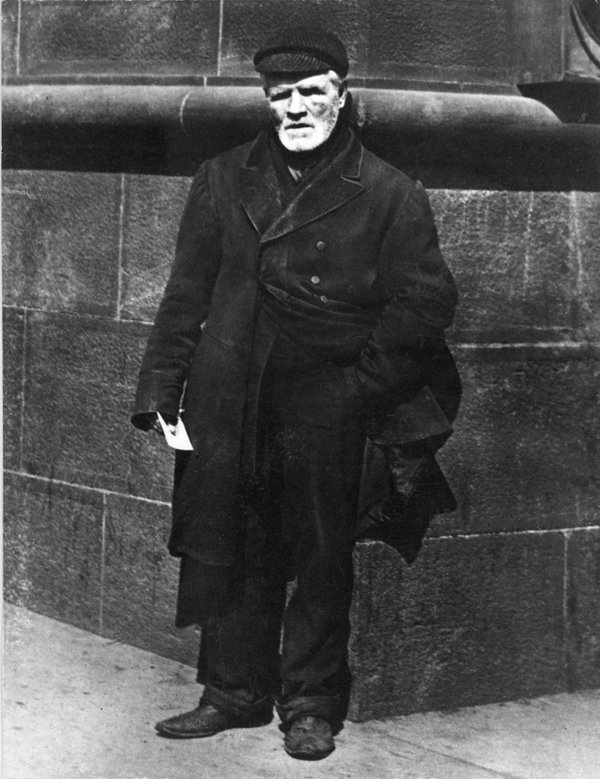 “Tommy on the Bridge”, late nineteenth century c.1898
One of the most familiar figures connected with the crossing was Thomas Ferens, better known as “Tommy on the Bridge”. Blind from childhood, Tommy became a well-known presence on the route between Newcastle and Gateshead and was recognised by generations of people crossing the river.
When he died in 1907, newspaper reports recorded the affection many local people felt towards him. One account recalled that he had first stood on the old Tyne Bridge before moving to the Swing Bridge after its opening. Another noted that he remained there in all weathers and became so closely connected with the crossing that many people knew him simply through that association.
His photograph reminds us that the history of the Swing Bridge is also a history of the people who used it, worked around it and made it part of their daily lives. As the bridge became part of everyday experience, it also became part of how people saw Tyneside itself.
From engineering structure to city symbol
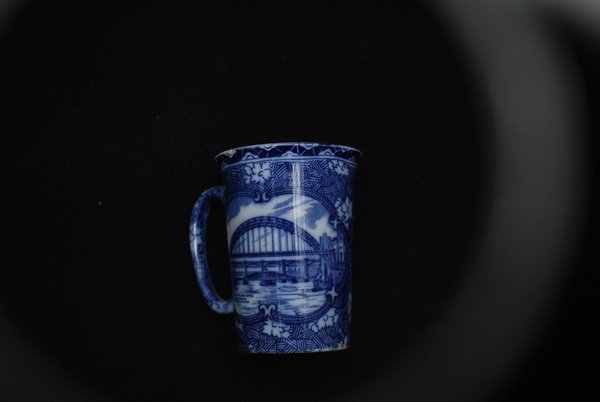 Souvenir mug showing the Tyne bridges, 1929
By the twentieth century, the Swing Bridge had become more than a piece of infrastructure. It had become one of the best-known sights on the Tyne.
This souvenir mug, produced for the North East Coast Exhibition in 1929, places the Swing Bridge alongside the High Level Bridge and the newly completed Tyne Bridge. The design shows how people saw the bridge as one of the defining features of the Tyne. Objects such as this show that people valued the bridge not only for what it did, but also for what it represented: engineering skill, industrial success and pride in the region.
What the collections reveal
The Swing Bridge was built to solve a practical problem, but the collections and archives that survive reveal something much bigger. They show the ambition of Victorian engineers, the growth of industry on the Tyne, the systems that kept a busy river moving, and the people whose lives became connected with the crossing.
One hundred and fifty years after it opened, the bridge remains a familiar part of the riverscape. Many of the shipyards and industries it once served have disappeared, yet the bridge still links Newcastle and Gateshead much as it did in 1876. Through the plans, objects, photographs and records preserved by Discovery Museum and Tyne & Wear Archives, we can continue to explore the story of a structure that helped shape both the river and the communities around it.
Bernard Musesengwe, Assistant Keeper of History, Discovery Museum





/https://s3-eu-west-1.amazonaws.com/atwam-images-files/production/images/content/twmuseums/2026-08/784527.jpg)
/https://s3-eu-west-1.amazonaws.com/atwam-images-files/production/images/content/twmuseums/2026-08/784531.jpg)
/https://s3-eu-west-1.amazonaws.com/atwam-images-files/production/images/content/twmuseums/2026-08/784533.jpg)
/https://s3-eu-west-1.amazonaws.com/atwam-images-files/production/images/content/twmuseums/2026-08/784535.jpg)
/https://s3-eu-west-1.amazonaws.com/atwam-images-files/production/images/content/twmuseums/2026-08/784633.jpg)