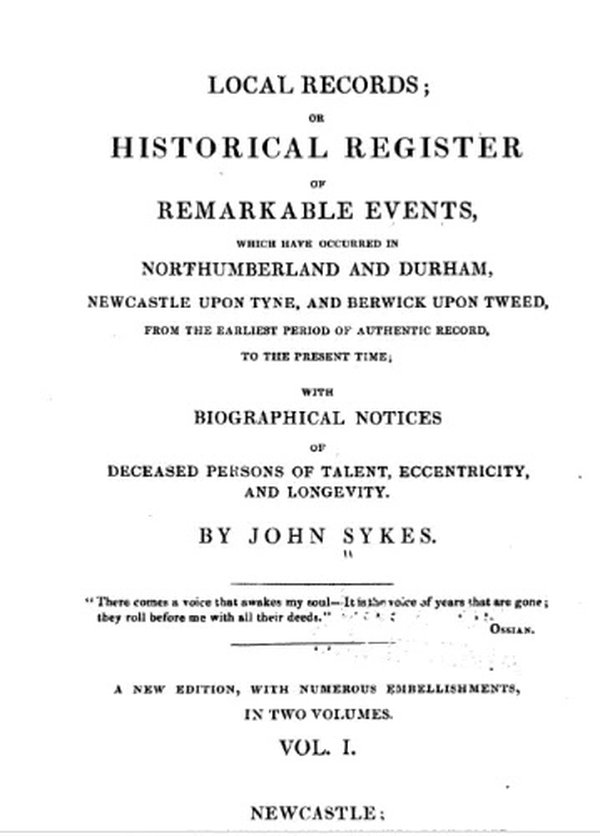
This tale of Newcastle’s late Georgian underbelly is inspired by extracts from Publications of the Folk-lore Society, Volume 2 and a most excellent book in Tyne & Wear Archives collection Local Records, or Historical Register of Remarkable Events: Which Have Occurred in Northumberland and Durham, Newcastle Upon Tyne, and Berwick Upon Tweed, from the Earliest Period of Authentic Record, to the Present Time; with Biographical Notices of Deceased Persons of Talent, Eccentricity, and Longevity, Volume II. John Sykes and Latimer.
There are those who place their faith in science: provable, clinical fact. There are those who place their faith in God; infallible, ineffable belief. And there are those people, for whatever sorry reason — ignorance, fear or pain — place their faith into the slippery palms of sinister, manipulative men…
There was a time in the 19th century when Newcastle was in the throes of burgeoning urban regeneration; the medieval town was eroding as a crop of dynamic men revolutionised the town. Formidable trio builder Richard Grainger, architect John Dobson and town clerk John Clayton were charging ahead and raising the town by building a network of impressive neoclassical streets.
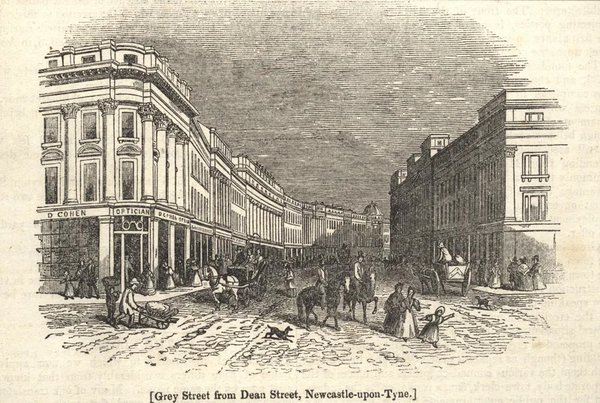 Grey Street, 1840. Collard after Carmichael J.W. Courtesy of Newcastle Libraries 003959
New Regency silhouettes four stories high cast novel shapes across the streets. Sweeping columns and the gentle curve of Grey Street leading toward the riverside compelled pedestrians to gape; turrets, domes and spikes of golden stone populated the new Newcastle. A grand theatre was planned, a music-hall, a huge indoor market. Change was afoot.
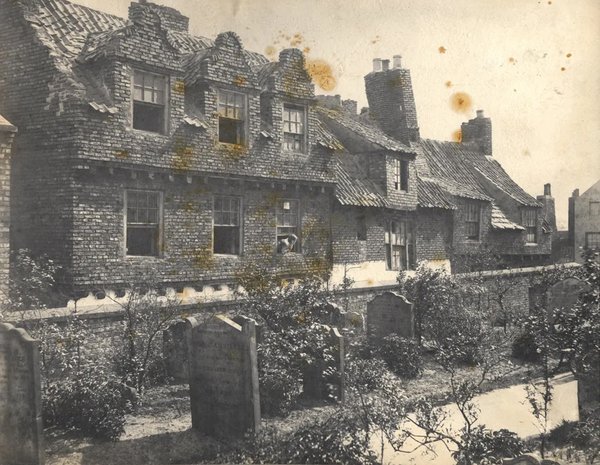 Church Lane Newcastle upon Tyne 1884. The photograph shows Church Lane and the rear of properties on Dog Bank as seen from All Saints Churchyard. Courtesy of Newcastle Libraries 004216
Not everyone was infected with the spirit of the Enlightenment, however. A short walk from these modern advances, the old superstitious ways still governed the life choices of certain people and fanned the folklore beliefs of the town and surrounding area.
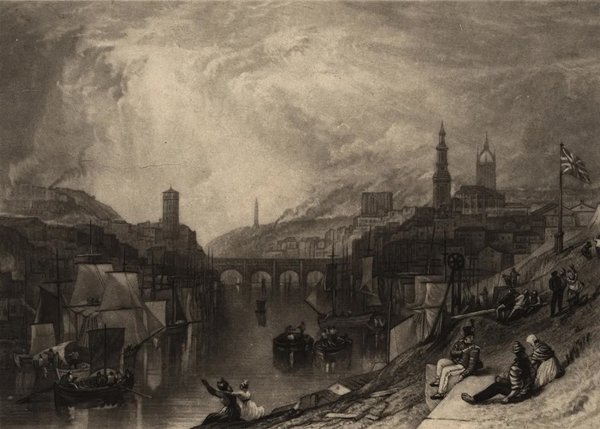 Newcastle upon Tyne Turner J.W. 1823 engraving of Newcastle upon Tyne, viewed from the ballast hills above the North shore of the River Tyne. Courtesy of Newcastle Libraries 013065A
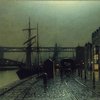
Let us take a trip down Newcastle Quayside, then; it would’ve been lively, with a stench of fish, folk and mud. On your daily jaunt maybe you’d jostle those munching on Anne Seth’s potted head bought at Amen Corner on their way to the spectacle of the Uncommon Fish at Sandhill; you’d hear the yapping of restrained pets — avoiding the mad-dog cull — over the strains of Blind Willies’ fiddle.
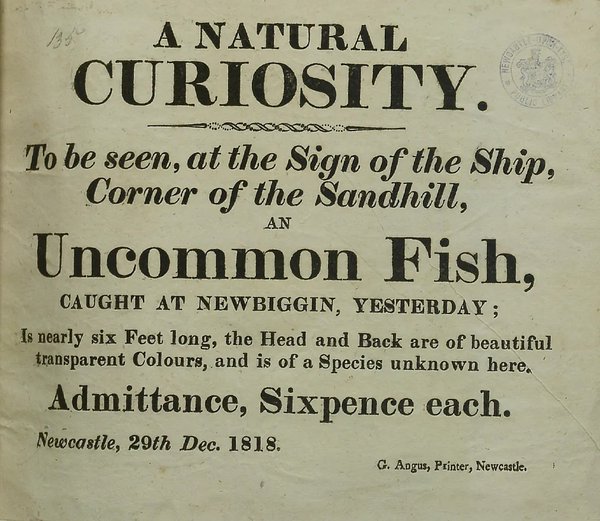 Potted head and uncommon fish newspapers
You’d certainly brush past someone who was slinking down to Dog Bank to see ‘Black Jackey’ Johnson, the mysterious powerful sorcerer of the town, shrouded in blood and secrecy; a master of dark arts whose reputation far surpassed the town walls for many miles around.
![Astronomy: various apocalyptic scenes, including a fire, war, and a necromancer conjuring a demon. Coloured lithograph, [c.1838].](https://d279tnhy9skgzk.cloudfront.net/D4nXfyjFkzdNDPwDkjLvYgD_KKU=/600x0/https://s3-eu-west-1.amazonaws.com/atwam-images-files/production/images/content/twmuseums/2026-08/760789.jpeg "Astronomy: various apocalyptic scenes, including a fire, war, and a necromancer conjuring a demon. Coloured lithograph, [c.1838].") Astronomy: various apocalyptic scenes, including a fire, war, and a necromancer conjuring a demon. Coloured lithograph, [c.1838]. Credit: Wellcome Collection. Attribution 4.0 International (CC BY 4.0)
Astronomy: various apocalyptic scenes, including a fire, war, and a necromancer conjuring a demon. Coloured lithograph, [c.1838]. Credit: Wellcome Collection. Attribution 4.0 International (CC BY 4.0)
If you’d been robbed, mislaid a treasure or craved a love spell to find a spouse, you called on ‘Black Jackey’. If you’d been cheated, you called on Black Jackey. If you’d been cursed with the evil eye — you called on Black Jackey. For a fee, of course.
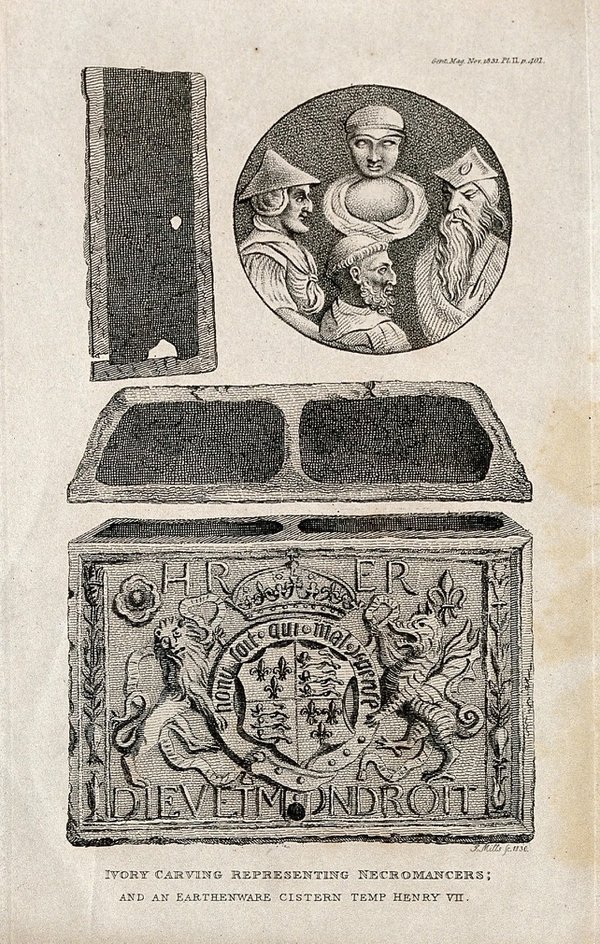 An earthenware cistern and an ivory carving representing necromancers, above. Etching by J. Mills, 1830. Credit: Wellcome Collection. Attribution 4.0 International (CC BY 4.0)
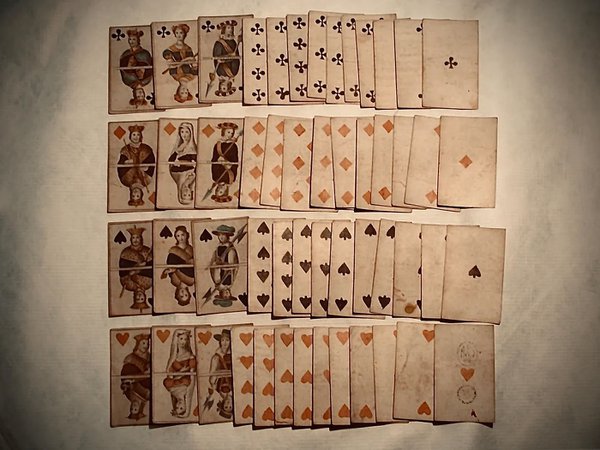
Self-proclaimed wizard and dressed from head to toe in black cloth, Jackey claimed he could see into people’s minds, slice through thoughts, and decipher the darkest parts of a person’s brain. He could wade though the innermost self of those who consulted him, grip their imagination, and fuel their fear. He communed with the dead and fearlessly dealt his cards to heed their advice. The seer of Newcastle had no necromancer peer.
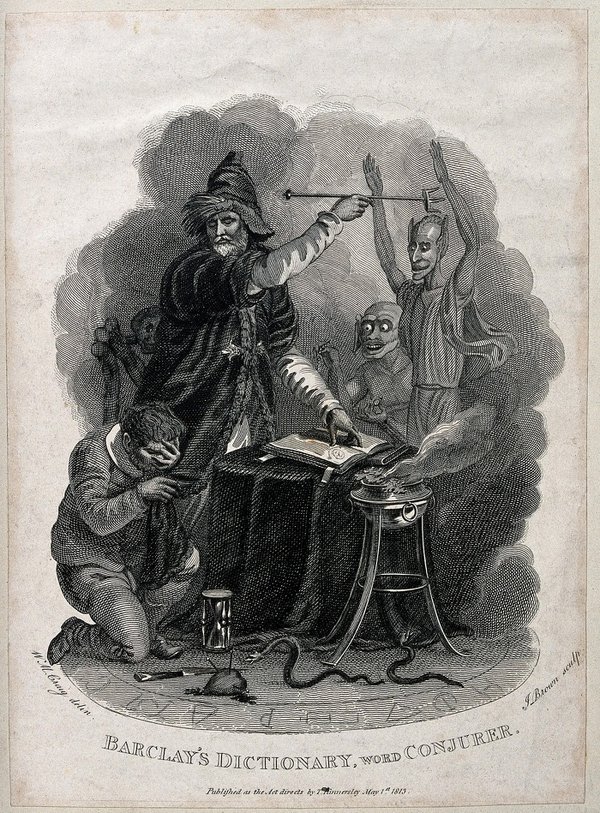 A conjurer casting spells with his wand and fire surrounded by a kneeling man and demons within the magic circle. Engraving by J. Brown after W.M. Craig, 1813. Credit: Wellcome Collection. Attribution 4.0 International (CC BY 4.0)
If you sought Jackey’s counsel you needed a strong stomach to practise his grisly rituals (to become invisible, you’d need to hold half the powdered heart of a cat, boiled for three hours on a Sunday.)
Jackey made it known he owned a book by astrologist Cornelius Agrippa, the notorious 15th century magician. With the tools of his trade — his grimoire, his cards, a mirror, his mind — he terrorised the local population, as well as the local hard men, with his ability to uncover the truth.
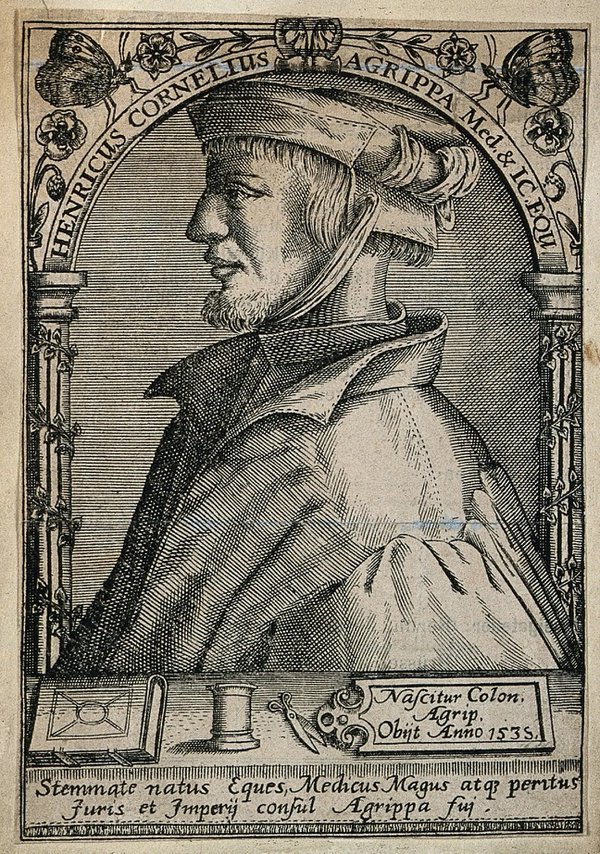 Henricus Cornelius Agrippa von Nettesheim. Line engraving, 1. Credit: Wellcome Collection. Attribution 4.0 International (CC BY 4.0)
![Three books of occult philosophy / Written by Henry Cornelius Agrippa of Nettesheim. Translated out of the Latin into the English by J.F[reake].](https://d279tnhy9skgzk.cloudfront.net/ftxSKzfScvYvZ6Eg1Z0ZwpaPhs0=/600x0/https://s3-eu-west-1.amazonaws.com/atwam-images-files/production/images/content/twmuseums/2026-08/760809.jpeg "Three books of occult philosophy / Written by Henry Cornelius Agrippa of Nettesheim. Translated out of the Latin into the English by J.F[reake].") Three books of occult philosophy / Written by Henry Cornelius Agrippa of Nettesheim. Translated out of the Latin into the English by J.F[reake]. Credit: Wellcome Collection. Attribution 4.0 International (CC BY 4.0)
Three books of occult philosophy / Written by Henry Cornelius Agrippa of Nettesheim. Translated out of the Latin into the English by J.F[reake]. Credit: Wellcome Collection. Attribution 4.0 International (CC BY 4.0)
Many of the criminal underclass, hearing that a person was to consult with Jackey, returned stolen goods straight away, afraid. Eventually his antics brought the town’s officials to his door, and Jackey was hounded from the town, but not far, to Byker Bank, where he continued to weave his web of fear and entrapment.
But this ringmaster of common people, this professor of dying arts, played his society with flair. A votary of Hymen — or a spellcasting matchmaker — he settled many a maid with a suitable husband.
So, it came to pass, that Black Jackey Johnson, occultist, invited a distraught man into his home.
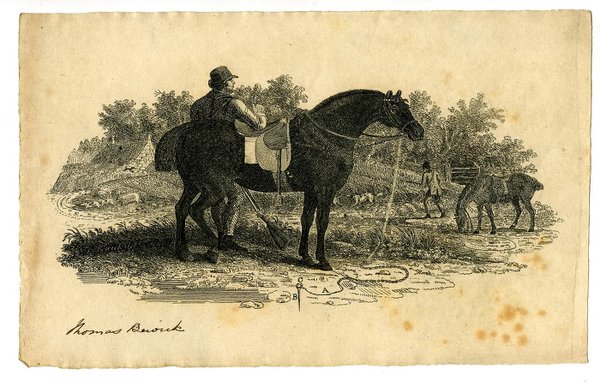 A short treatise on that useful invention called the sportsman’s friend; or the Farmer’s Footman. Thomas Bewick 1801. Archives of Natural History Society of Northumbria (NEWHM_1997_H74-c)
Northumbrian farmer William Pringle from Richmond Hill was devastated. His prize mare had endured a horrible death during the night. In shock, William sputtered that she had served his family with loyalty, grace, and bloodline. His son had clung to her gentle fetlocks when he was learning to walk. They had loved her.
Jackey sat back when William calmed down and appeared to drift off for several minutes; eventually he opened his eyes and declared that the horse had been poisoned by brewer’s grains, and that he could help William discover who had done this. For a fee of £1 — about £100 today. A stupefied William bumbled his way home after discovering what he must do to uncover the poisoner. In utmost secrecy he enlisted his trusted servant Forster Charlton to help.
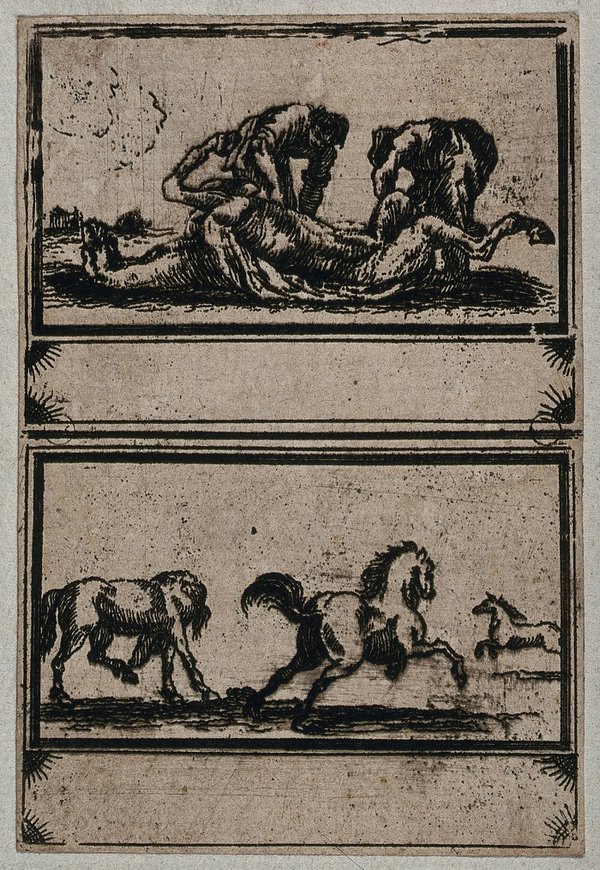 Top, two men inspecting a dead horse; Bottom, three horses running. Etching. Credit: Wellcome Collection. Attribution 4.0 International (CC BY 4.0)
A dead horse is hard to move. Together, in the cloying dark and stink of an old farm shed under the dimmest of lamps, they cut up the corpse of the animal. William gagged as Chorlton slit the mare’s front and a puff of rancid gas hit his face. The saw they used to hack through her breastbone buckled and stuck. The loud crack as they reached in to wrench out her faintly warm heart was a relief.
William and Forster then, at Jackey’s instruction, made the home airtight — windows were closed, tow fabric stuffed into every crack and space. They hovered hands across doors to find drafts to plug. And so, the ritual began, as the household slept. By Jackey’s advice the mare’s bloody and ragged 15 pound heart was stuffed with pins, and set to roast over the fire, between the hours of 11 and midnight, when they were to open the door to see the culprit. Upon the stroke of midnight, they opened the door, expecting to accost the dastardly character who had slighted William; instead they saw a kindly and well thought of neighbour on his journey home and a very perturbed William was not convinced.
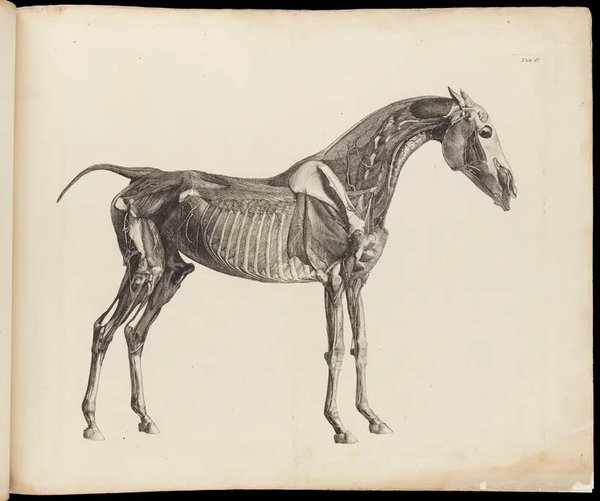 Muscles, bones and blood-vessels of a horse: an écorché figure, side view. Engraving with etching by G. Stubbs, 1766. Credit: Wellcome Collection. Attribution 4.0 International (CC BY 4.0)
At the light of day William charged into town and summoned Black Jackey to the farm. After inspection Jackey found a small hole in the house and berated the horrified men passionately for their carelessness (for it was his reputation at stake, and a Durham man had done this spell before with great success) and that the chance had now passed to uncover the murderer.
Such was the power of Black Jackey; but while Newcastle was rising into the new landscape that we know today, Newcastle’s purveyor of witchcraft was on the wane.
Black Jackey went out in style; on the last day of March, Jackey was communing with those spirits he had so much faith in, at the table of his house in Byker. While dealing his cards, he stopped, suddenly — and stayed like that for three days, never saying a word, until his death upon 3 April. What had he seen?
Was Black Jackey Johnson a wily, peace-keeping charlatan? Or a dangerous dark magician?
Whatever he was and whoever he was, Black Jackey Johnson, Newcastle’s last professor of magic, expired, doing what he’d made his nefarious living doing, communing with the dead.
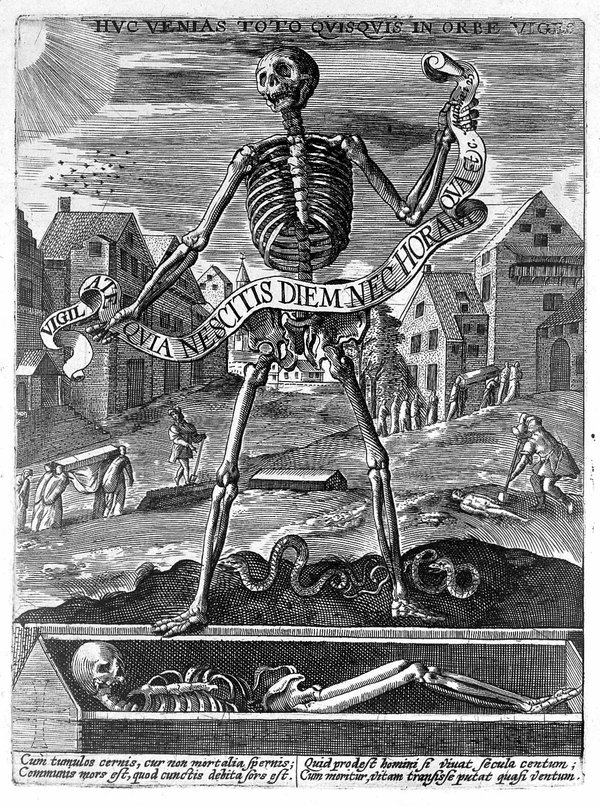 Allegory of death: skeleton, c.1600. Credit: Wellcome Collection. Attribution 4.0 International (CC BY 4.0)
Vicki Page, Communications Officer, North East Museums



/https://s3-eu-west-1.amazonaws.com/atwam-images-files/production/images/content/twmuseums/2026-08/760799.jpeg)
/https://s3-eu-west-1.amazonaws.com/atwam-images-files/production/images/content/twmuseums/2026-08/760838.jpeg)
/https://s3-eu-west-1.amazonaws.com/atwam-images-files/production/images/content/twmuseums/2026-08/760762.jpeg)
/https://s3-eu-west-1.amazonaws.com/atwam-images-files/production/images/content/twmuseums/2026-08/760764.jpeg)
/https://s3-eu-west-1.amazonaws.com/atwam-images-files/production/images/content/twmuseums/2026-08/760766.jpeg)
/https://s3-eu-west-1.amazonaws.com/atwam-images-files/production/images/content/twmuseums/2026-08/760771.jpeg)
/https://s3-eu-west-1.amazonaws.com/atwam-images-files/production/images/content/twmuseums/2026-08/760777.jpeg)
/https://s3-eu-west-1.amazonaws.com/atwam-images-files/production/images/content/twmuseums/2026-08/760782.jpeg)
/https://s3-eu-west-1.amazonaws.com/atwam-images-files/production/images/content/twmuseums/2026-08/760784.jpeg)
![Astronomy: various apocalyptic scenes, including a fire, war, and a necromancer conjuring a demon. Coloured lithograph, [c.1838].](https://d279tnhy9skgzk.cloudfront.net/jWh9oD569IBRe1BaBuso9BwkRb4=/fit-in/1000x600/filters:no_upscale()/https://s3-eu-west-1.amazonaws.com/atwam-images-files/production/images/content/twmuseums/2026-08/760789.jpeg)
/https://s3-eu-west-1.amazonaws.com/atwam-images-files/production/images/content/twmuseums/2026-08/760794.jpeg)
/https://s3-eu-west-1.amazonaws.com/atwam-images-files/production/images/content/twmuseums/2026-08/760804.jpeg)
![Three books of occult philosophy / Written by Henry Cornelius Agrippa of Nettesheim. Translated out of the Latin into the English by J.F[reake].](https://d279tnhy9skgzk.cloudfront.net/PwN8Lk5-2R81v4tdKVuYdwHtFco=/fit-in/1000x600/filters:no_upscale()/https://s3-eu-west-1.amazonaws.com/atwam-images-files/production/images/content/twmuseums/2026-08/760809.jpeg)
/https://s3-eu-west-1.amazonaws.com/atwam-images-files/production/images/content/twmuseums/2026-08/760815.jpeg)
/https://s3-eu-west-1.amazonaws.com/atwam-images-files/production/images/content/twmuseums/2026-08/760822.jpeg)
/https://s3-eu-west-1.amazonaws.com/atwam-images-files/production/images/content/twmuseums/2026-08/760829.jpeg)
/https://s3-eu-west-1.amazonaws.com/atwam-images-files/production/images/content/twmuseums/2026-08/760844.jpeg)