The Red-Necked Wallaby
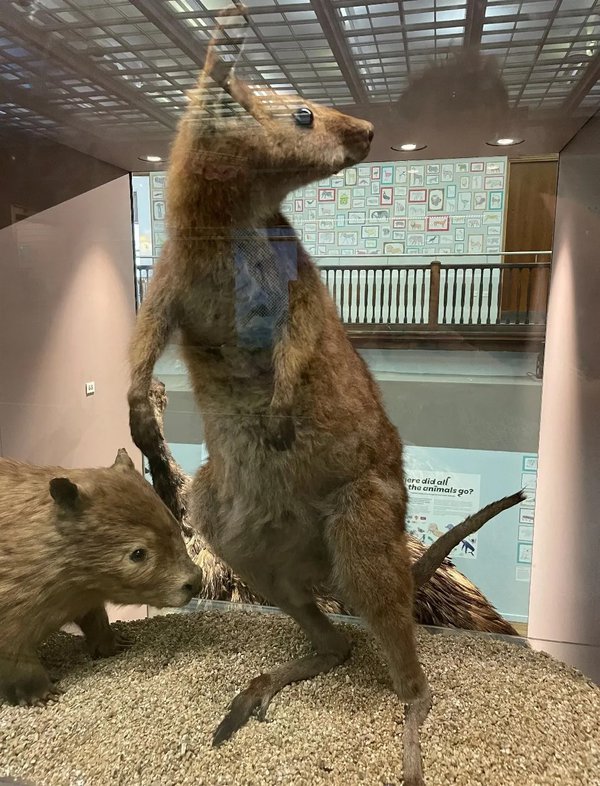 Red-necked/Bennett’s Wallaby on display in the Living Planet Gallery
The Wallaby has been a very interesting specimen to uncover. The search began with a list of nine specimens being donated to the NHSN in 1886 by ‘Trustees of the Australian Museum’. It can be assumed that these ‘Trustees’ were the 24 members of the Board who oversaw the running of the museum from 1853 to 1975. 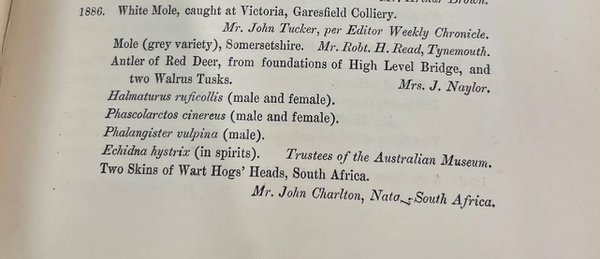
Transaction records in the Natural History Society of Northumbria archives — list of donations in the year 1886 with highlighted section showing the donations from Australian Museum.
In the NHSN transactions, one item is listed as a ‘Halmaturus ruficolis’ or otherwise known as a Rufous-necked wallaby. However, searches did not bring up much information using this scientific name. It appears that the scientific name was changed at some point to ‘Macropus rufiogriseus’, whose common name is ‘Bennett’s wallaby’ (a subspecies of Red-Necked wallaby). The Living Planet Gallery houses a Red-Necked Wallaby with no previously known provenance. It is likely that this is our Australian Museum specimen.
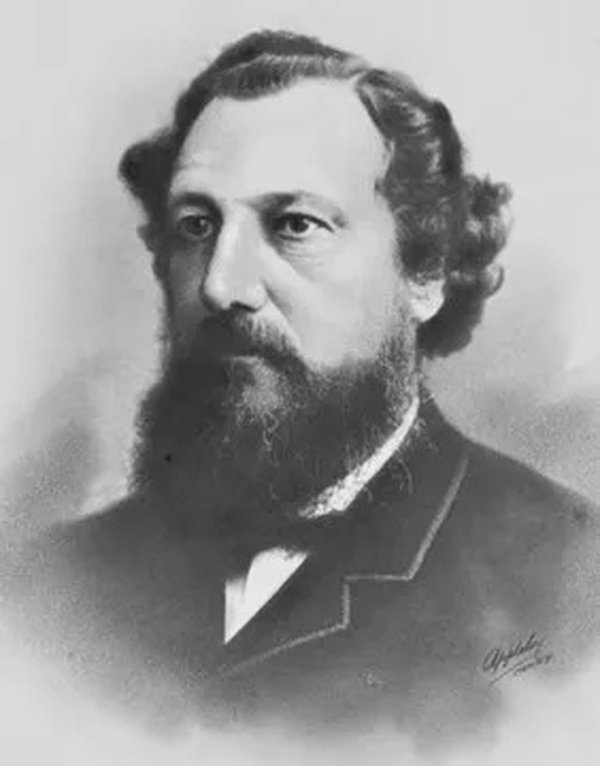 Edward Pierson Ramsay Curator of the Australian Museum from 1876 to 1894 (© Australian Museum G. Millen 2019)
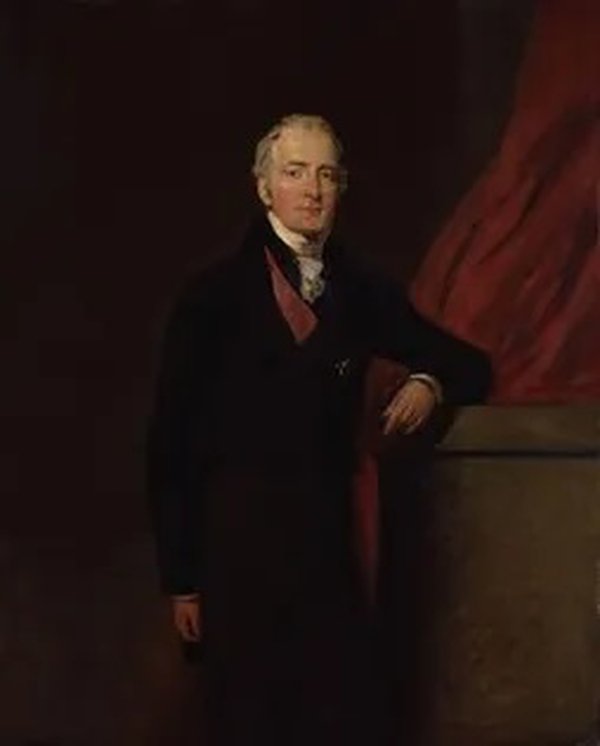 Henry Bathurst 3rd Earl of Bathurst who became Secretary of State for War and the Colonies in 1812 (Painting by William Salter © National Portrait Gallery NPG 3697)
The Australian Museum, initially called the Sydney Museum or ‘Colonial Museum’, was founded by Earl Bathurst who was British Secretary of State for the Colonies in 1827. The Mammalian curator at the time of our donations was a man called Edward Ramsay, the first Australian born curator with an early interest in natural history. In 1868, before his time as curator, Ramsay joined his brothers in a sugar-growing plantation in Queensland; despite their plantation eventually collapsing, his wealth was therefore aided by partaking in colonial administration of plantations.
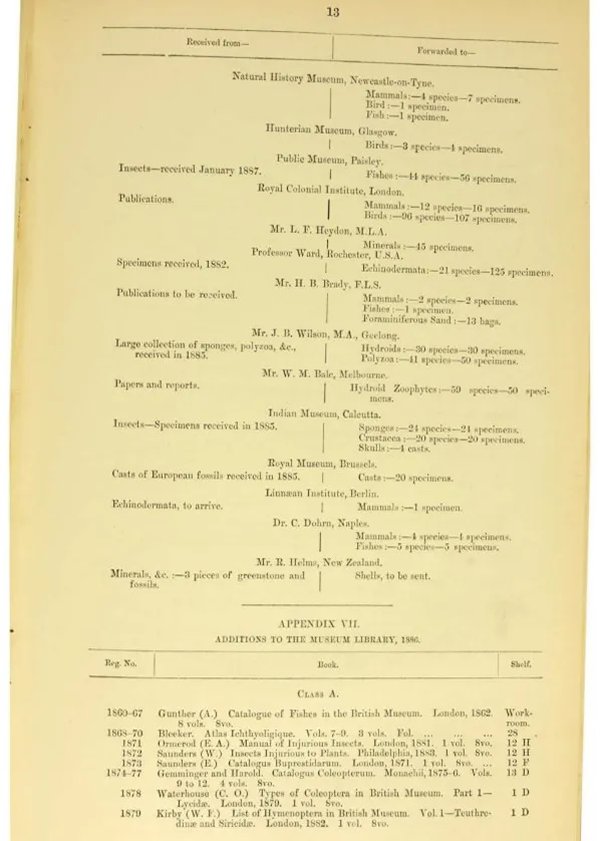 Document from the Reports from the Trustees of the Australian Museum from the same year detailing the same transaction with the NHSN ( © Australian Museum Annual Transactions )
In a stroke of luck, it has been possible to take the story of this specimen to its beginning across the world in Australia. We now know that it came from the Boro Braidwood district in New South Wales, it was donated by a J.A. Thorpe in July 1883, and we now know it is a female wallaby. New information such as this allows us to gain a greater understanding of our collections, the life histories of these objects and the real animal’s background before they had arrived into Newcastle.
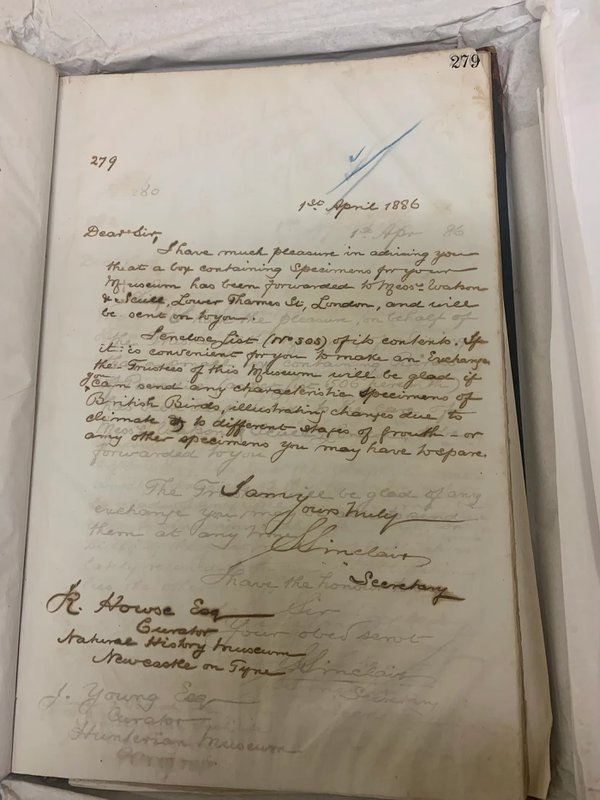 Australian Museum letter of exchange with the Natural History Society of Northumbria in 1886 ( © Australian Museum courtesy of Robert Dooley)
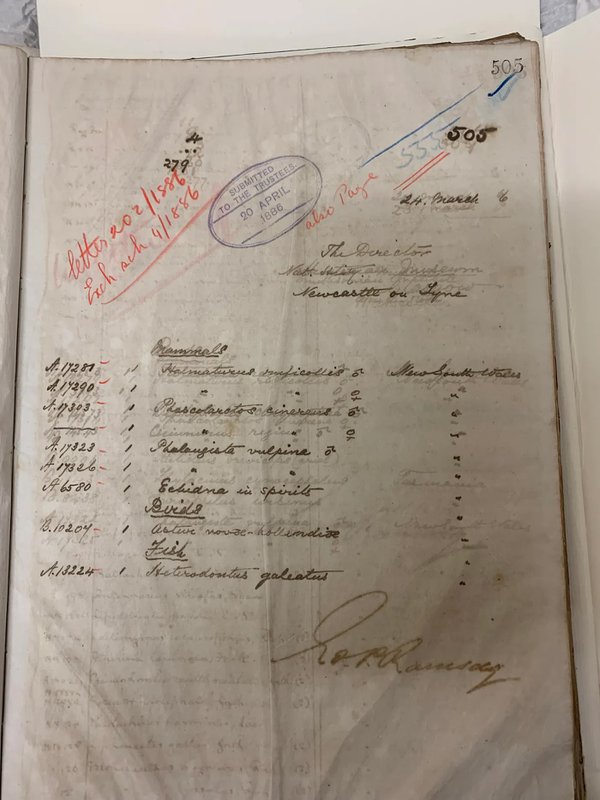 Australian Museum original accession records — our wallaby is listed as specimens A17281 and A17290 ( © Australian Museum courtesy of Robert Dooley)
Despite this, we always have more questions than answers in collections research. We still do not know who conducted the taxidermy work for this specimen, nor how it specifically came into the museum. It could be assumed that it arrived via Newcastle’s steam ships which also brought over the famous Wombat and Duck-Billed Platypus from John Hunter, Governor of New South Wales in Australia in 1798.
Bennett’s wallaby populations have continued to decline in Tasmania due to a rise in hunting in the 1970s, with a particular affinity for hunting the males over the females. Endangered animals is a common outcome from colonial ruling due to the over-hunting which took place. Australia was unfortunately also subject to the effects of game trophies and over-hunting by naturalists for scientific purposes which swept parts of Africa.
The Crested Porcupine
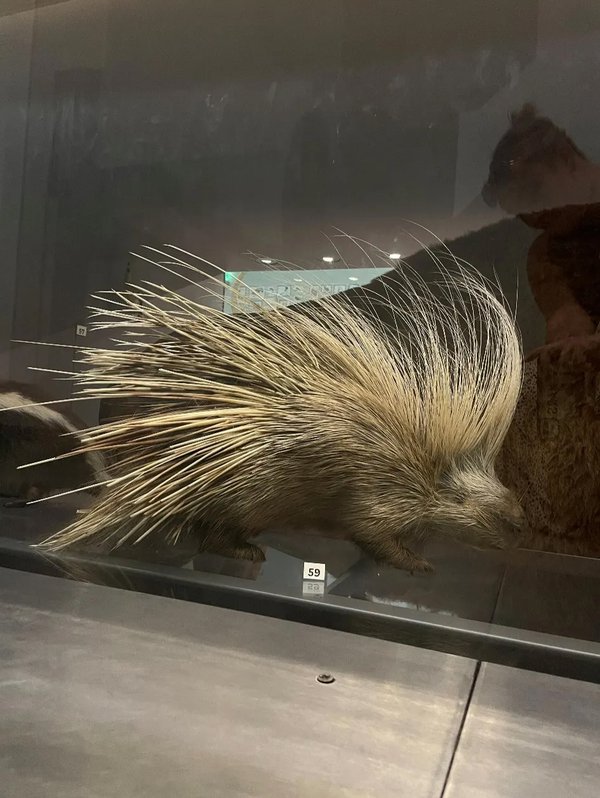 Crested Porcupine on display in the Living Planet Gallery
Newcastle can therefore be seen as a site of exchange with transnational and international institutions. With its bustling steam ship trade, it comes as no surprise that a variety of importations arrived on our doorstep from countries Britain ruled over. This is further displayed by our Crested Porcupine.
The Crested Porcupine is listed in the Society’s transactions as being purchased in 1892 from a ‘Travelling Menagerie’. A quick search surfaced information that Newcastle was a frequent host to the famous Bostock and Wombwell’s Travelling Menagerie, with their last ever performance in 1931 being shown at the Cattle Market (which is now Times Square at the Centre for Life). Unfortunately, it is likely that our porcupine does not have the best of histories.
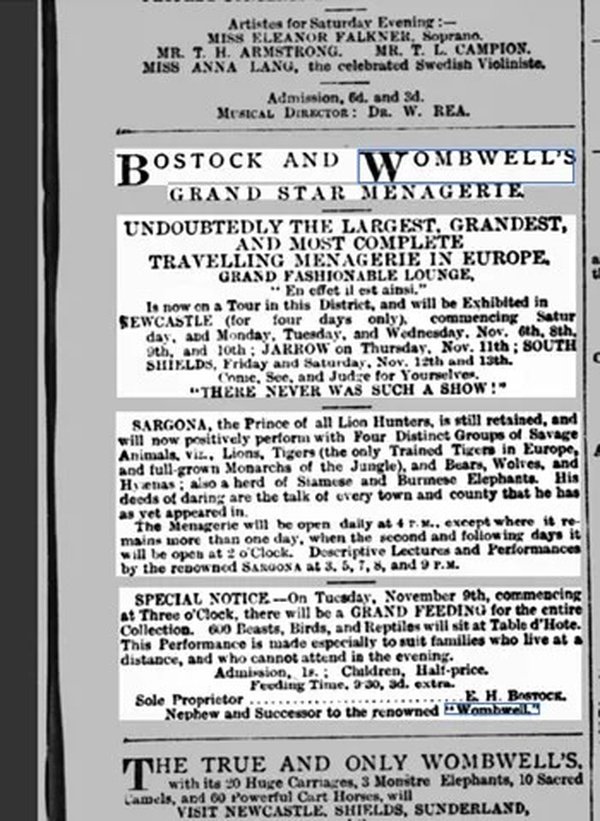 Newspaper clipping from Saturday 8th November 1886 in The Evening Chronicle detailing the 4 day-long event being held in Newcastle ( © The British Newspaper Archive)
Bostock and Wombwell’s Travelling Menagerie, although known for its spectacle of colour, exoticism and adventure, has a darker past. Their extravagant displays of wild animals would excite everyone who lined the streets to watch parades or gathered in squares to marvel at the contents in the cages. Beginning with George Wombwell in 1804, Menageries began to emerge around the world at the beginning of the 19th century and lasted through to the first part of the 20th century. Menageries fed into the Victorian ideal of displaying the wonders of the British Empire, with wild and exotic animals paraded around and under the strict control of their Western show master.
However, because these are ‘exotic’ animals they obviously have not originated from Britain; so how did they end up here? Colonial ‘scientific’ expeditions led by naturalists eventually supplied a vast amount of zoos and menageries, but this was not an important factor in their collections when on colonial lands. Two further groups therefore performed important roles within exotic animal trade; commissioned agents and dealers in wild beasts. It is likely that Bostock and Wombwell had links to either one of these with a special reputation evolving with colonial administrators who regularly supplied them with their animals.
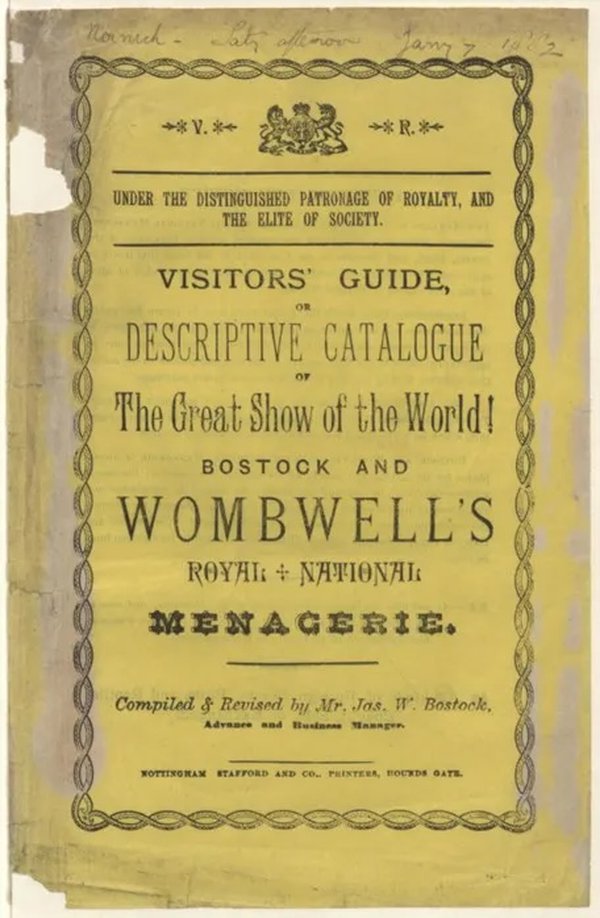 The descriptive catalogue which details the animals on display in the Menagerie, with a Crested Porcupine listed ( © January 7th 1882 The Johnson and Johnson collection, Oxford University)
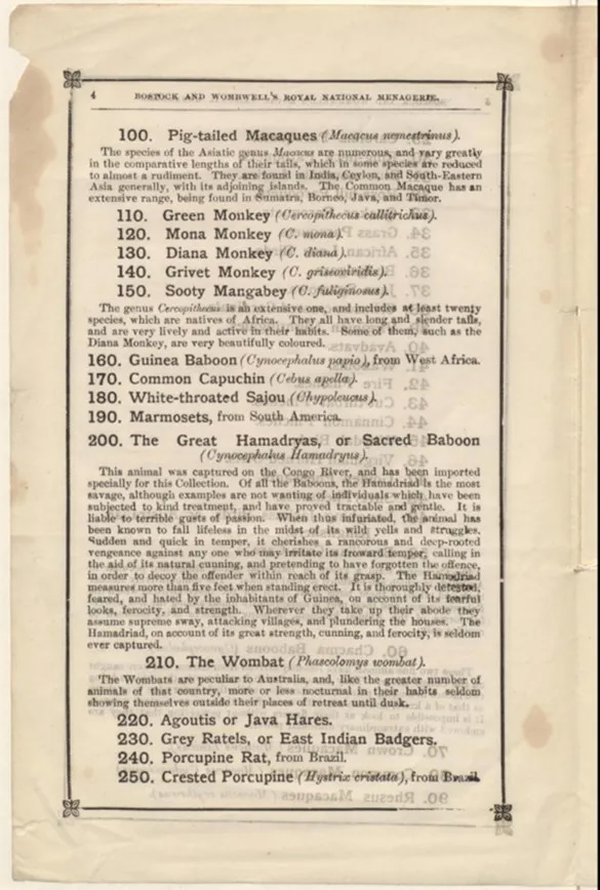 The descriptive catalogue which details the animals on display in the Menagerie, with a Crested Porcupine listed ( © January 7th 1882 The Johnson and Johnson collection, Oxford University)
Documentation evidences that Crested Porcupines were a regular attraction in the menageries. With donations highlighting that in 1841, Captain Stubbs presented a Crested Porcupine to The Gardens of the Zoological Society (now known as London Zoo), who often subsequently bestowed animals to menageries and museums. Often it would be such colonial diplomats and officers like Stubbs who were given additional orders to capture animals which were unusual or interesting while conducting colonial administration or exploration work in countries in Africa or the Americas. It is likely that our museum received the porcupine specimen once it had sadly passed away after being showcased in the menagerie to thousands of spectators.
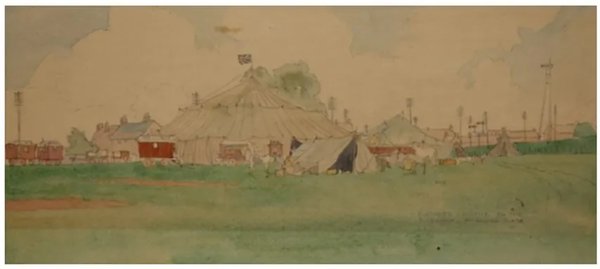 Watercolour of the Menagerie at Exhibition Park
Clearly such animals were not subject to the strict welfare laws we have in place today. It is important to keep this in mind when collating object biographies for the taxidermy collection as it can be easy to forget that these specimens were once living beings with a past life before their arrived to our display cabinets. It also raises important contemporary issues regarding our current human-animal relationships; what is the role of zoos in today’s world if not also participating in sanctuary work? How has veganism/vegetarianism changed our perspective towards animals? How can we save our climate and habitats to protect animals who are currently going extinct? These are important issues which the museum can help in untangling by looking back on our history and learning from it rather than repeating it.
The Aardvark
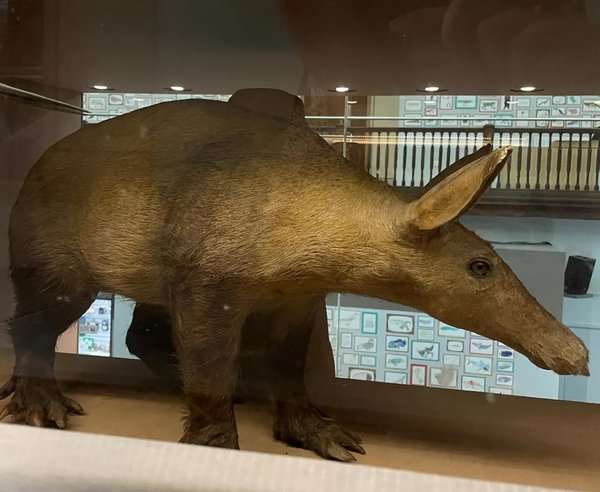 Aardvark on display in the Living Planet Gallery
Purchased in 1921 by the NHSN from a Mr. R. R Sharp, this Aardvark has remained a partial mystery. Due to the lack of documentation, it has been difficult to find further information on Sharp, the reason he was in Congo, and whether it was he himself who hunted and shot this aardvark or a third party. What I was able to uncover was that the Aardvark was collected “in Fungurume Katanga (nr.), Belgian Congo, Africa”. I was also able to discover a separate document which details Sharp as being commissioned by the Belgian government to collect specimens for Brussels Museum in 1914 — although not directly relating to our Aardvark, this document included photographs of large game which had been hunted and shot in Congo and gives us some possible clues as to Sharp’s position and reasons he could have had this Aardvark in his possession.
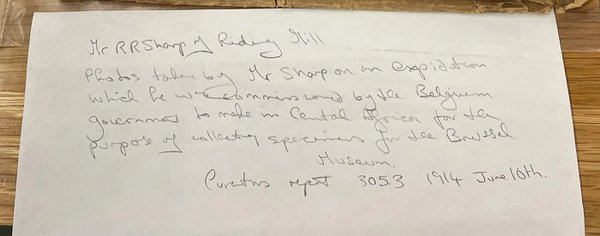 Document about R.R. Sharp’s link with the Belgian government from the NHSN Archives
Colonial tourism developed in many colonised countries which brought in profits for the colonising government. Specifically in Belgian Congo, Big Game Hunting via ‘Congo tours’ were advertised to prospective game hunters who were given special permissions to partake in game hunting. The political situation of these ‘special permissions’ is a huge issue within the world of conservation, in understanding the histories of colonial controlling of land and how early origins of conservation were justified. National Parks, including the likes of Albert, Kruger and Katanga (where our specimen is from), were created to “protect” the colonial flora and fauna especially of the wild, exotic and native species. Yet they were also created to “promote scientific research” and “encourage tourism insofar as this is compatible with the protection of nature”.
So what does this mean? This is where the true motives of the Belgian colony begin to shine through, with a control of the land and its wildlife the perfect establishment of an imperial rule which shows a sense of strength that Belgium should be the ones in charge of Congo. These exceptions to game hunting which were given to colonial tourists, naturalists and scientific officials excluded indigenous communities from their land; yet they often called on them to require their assistance in hunts.
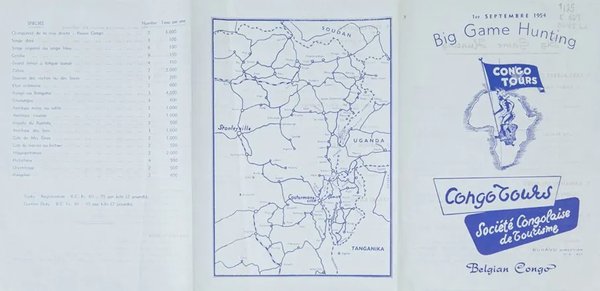 Belgian Congo: Congo Tours Promotional Brochure, September 1954. Giving safari rates, what they include, costs of licenses and trophy fees
As part of this creating of object biographies, it is also important to note the progression of how the animal went from living in its own environment to being on display. For this specimen, we also know that Rowland Ward (1848–1912) was the taxidermist responsible for its mounting. Ward was a renowned taxidermist situated in London, with many big-game trophies in our collections also being mounted by Ward. The boom of trophy hunting coincided with the boom of Ward’s business with Rowland Ward Ltd. being the only organisation to have extensive records of the trophies collected by the colony’s elites and dignitaries. Although it is not a lot of information, every small detail aids us in building up a clearer narrative of our collections and their origins and the journeys they have gone through so that we can create a more engaging and knowledgeable museum collection.
Researching these objects and the collection as a whole is far from finished; the museum is actively participating in the creation of object biographies which will create a better sense of how we received these objects into the museum and thus allowing museum visitors to become fully immersed in the collections on display.



/https://s3-eu-west-1.amazonaws.com/atwam-images-files/production/images/content/twmuseums/2026-08/761703.jpeg)
/https://s3-eu-west-1.amazonaws.com/atwam-images-files/production/images/content/twmuseums/2026-07/759640.jpeg)
/https://s3-eu-west-1.amazonaws.com/atwam-images-files/production/images/content/twmuseums/2026-07/759638.jpeg)
/https://s3-eu-west-1.amazonaws.com/atwam-images-files/production/images/content/twmuseums/2026-08/761567.jpeg)
/https://s3-eu-west-1.amazonaws.com/atwam-images-files/production/images/content/twmuseums/2026-08/761576.jpeg)
/https://s3-eu-west-1.amazonaws.com/atwam-images-files/production/images/content/twmuseums/2026-08/761578.jpeg)
/https://s3-eu-west-1.amazonaws.com/atwam-images-files/production/images/content/twmuseums/2026-08/761594.jpeg)
/https://s3-eu-west-1.amazonaws.com/atwam-images-files/production/images/content/twmuseums/2026-08/761610.jpeg)
/https://s3-eu-west-1.amazonaws.com/atwam-images-files/production/images/content/twmuseums/2026-08/761619.jpeg)
/https://s3-eu-west-1.amazonaws.com/atwam-images-files/production/images/content/twmuseums/2026-08/761642.jpeg)
/https://s3-eu-west-1.amazonaws.com/atwam-images-files/production/images/content/twmuseums/2026-08/761651.jpeg)
/https://s3-eu-west-1.amazonaws.com/atwam-images-files/production/images/content/twmuseums/2026-08/761662.jpeg)
/https://s3-eu-west-1.amazonaws.com/atwam-images-files/production/images/content/twmuseums/2026-08/761664.jpeg)
/https://s3-eu-west-1.amazonaws.com/atwam-images-files/production/images/content/twmuseums/2026-08/761680.jpeg)
/https://s3-eu-west-1.amazonaws.com/atwam-images-files/production/images/content/twmuseums/2026-08/761726.jpeg)
/https://s3-eu-west-1.amazonaws.com/atwam-images-files/production/images/content/twmuseums/2026-08/761745.jpeg)