300 million years ago
Fossil found of the world's largest recorded arthropod

Arthropleura · Fossil
300 million years ago
Fossil found of the world's largest recorded arthropod
Howick sands
Arthropleurae lived in Northumberland during the Carboniferous period, 326 million years ago. They were creatures similar to a millipede or centipede, only much bigger. A fragment of a fossil found at Howick is only partial, but from this the Arthropleura is estimated to have been 2.7 metres long, making this the largest known land arthropod (creatures like crabs, insects and spiders) to have existed. Most fossils, including this one, are of a shed exoskeleton or shell, rather than the creature itself. It ate seeds from the forest floor, or possibly small amphibians, and might have moved between the land and water amphibiously.
At this time the area had a tropical climate, as it lay near the equator, part of the giant landmasses of Laurussia and later, Pangea. It would have lived in the huge swampy forests or coastlines. Arthropleura existed for about 45 million years, before becoming extinct in the Permian era, possibly as its landscape became drier.
The fossil was found at Howick in January 2018, by a former Cambridge Phd student, who saw amongst boulders lying on the beach one recently split open, bearing a fossil. The fossil was extracted to prevent it eroding, and is now at Cambridge University's Sedgewick Museum.
Explore more from our collections and beyond
https://www.esc.cam.ac.uk/news/largest-ever-fossil-millipede-found-northern-england
https://pubs.geoscienceworld.org/gsl/jgs/article-abstract/179/3/jgs2021-115/610403/The-largest-arthropod-in-Earth-history-insights?redirectedFrom=fulltext
https://www.nhm.ac.uk/discover/news/2024/october/largest-ever-millipede-head-revealed.html
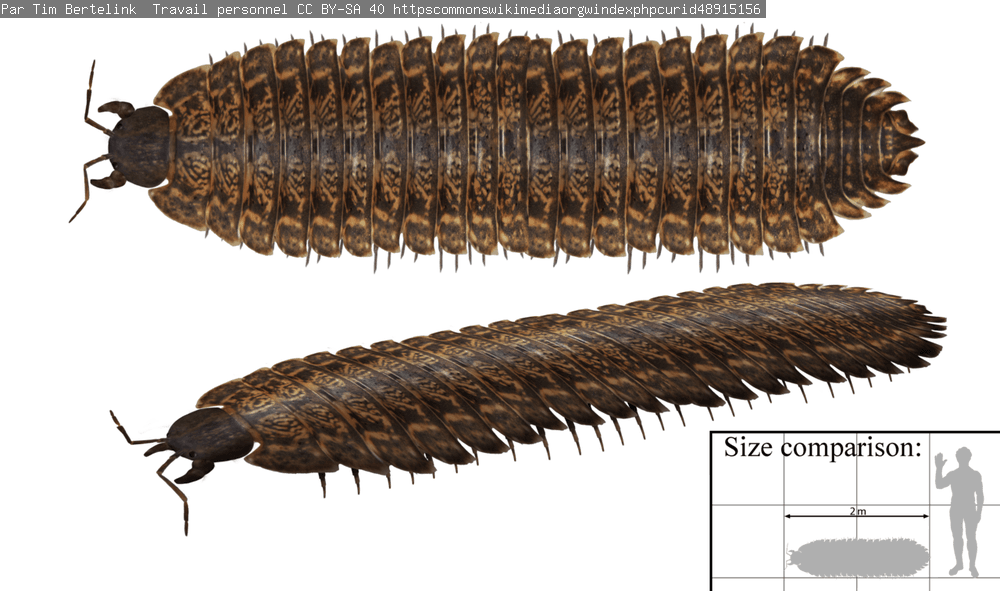
An artists impresssion of the giant millipede Arthropleura. By Tim Bertelink — personal work, CC BY-SA 4.0, via Wikimedia Commons