Unlocking the hidden in oral histories
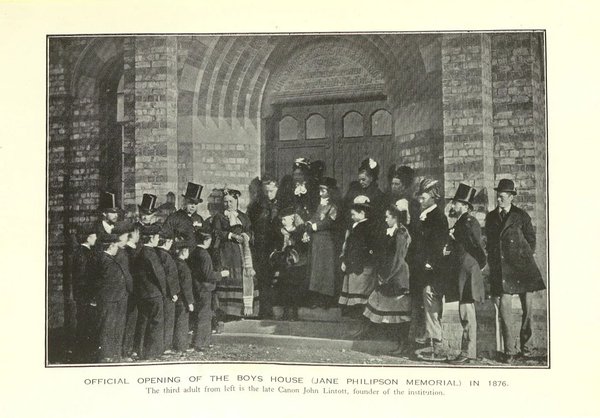
Today I am listening to Harry Dawson. Harry tells me how at the age of 8 years old he was ‘thrust’ into an orphanage. Harry’s voice gives no clues to his emotions. There is no catch in his throat as he tells me that his mother died giving birth and that his father was killed in the first world war; no tightening of the vocal chords, that might reveal bitterness at being turned out from the orphanage at age 16, with only a suit and a copy of the bible; no sing song of pity for his boyhood self, alone in the world. I ask myself; is Harry disguising his voice to hide anger at teachers who kept him and the other 83 boys under strict control night and day? Why does Harry not cry as he tells me that as a boy he owned nothing, had only a few shared toys and had to stoke boilers from the age of 12?
Can I hear Harry without the filter of my emotions, my opinions, my prejudices?
Harry tells me he was asked to write about orphanage life for the BBC. At first listening, these are simply humorous little stories about singing in church under the watchful eye of priests and bishops, a tennis session interrupted by a pair of white doves, a boy getting the stub of a pencil stuck in his ear. But woven into these stories are — perhaps subconscious — illustrations of another side of orphanage life. A little boy being frightened he will land in hell for simply singing with vibrato in his voice. That same boy being punished and humiliated for simply being left handed, and receiving half a crown at Christmas from a generous benefactor, but then having to resign that half crown to the headmaster, who would deduct the cost of a pencil, a bootlace or a garter, leaving little or nothing by the end of term, to buy even ‘..one foot of Sticky Spanish.’
The recording concludes with an urgent codicil in which Harry’s voice, for the first time, perhaps shows traces of something like defensiveness?
‘I’d like, before I finish, to put in a little note which was sent to the BBC about the orphanage, in case there’s some misgivings about it being a cruel place and people get peculiar ideas. But never mind, this is what I wrote to the BBC…’
‘Many facts can be told that cannot be put into stories, for instance, how did you arrive in an orphanage? These were not children found destitute and picked up from the streets, these went to poor law institutions like the work house. These boys and girls came from middle class working people, they came from places as far as Hexham, Sunderland, Durham and the whole of the North East. If tragedy hit your family and your guardians knew certain people like masonic brethren or some influential people who were on the board of governors of the orphanage, they’d pass their vote to you. If you were lucky you got in. In my case my elder brother got in free, but as we were not to be separated they took me also, taking a small amount from what little money my father had left. After this you were the legal property of the orphanage.
Unfortunately this was all done when the children were young and did not understand. Many had to leave the orphanage at 16 with no family background and no financial support. But I must say this in defence of the orphanage. I received a very strict upbringing, educated above the normal given in council schools, was fed and clothed by people who were charitable and public spirited. This of their time never to be able to repay. And I was a happy child among many friends, who like myself, had to fight to survive. We were made to be responsible for all our actions, perhaps too early in life, but we all did well later on.’
I listen to Harry for a third, fourth, fifth time. Each listening reveals more of the man from the stories of the boy.
The Emotional Gap
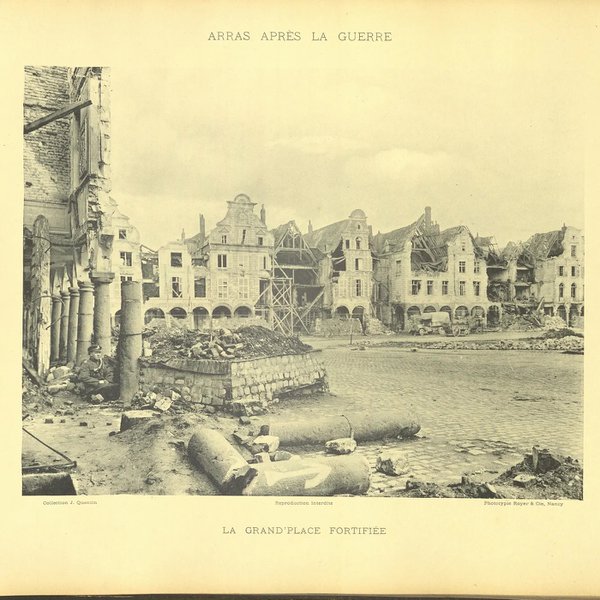
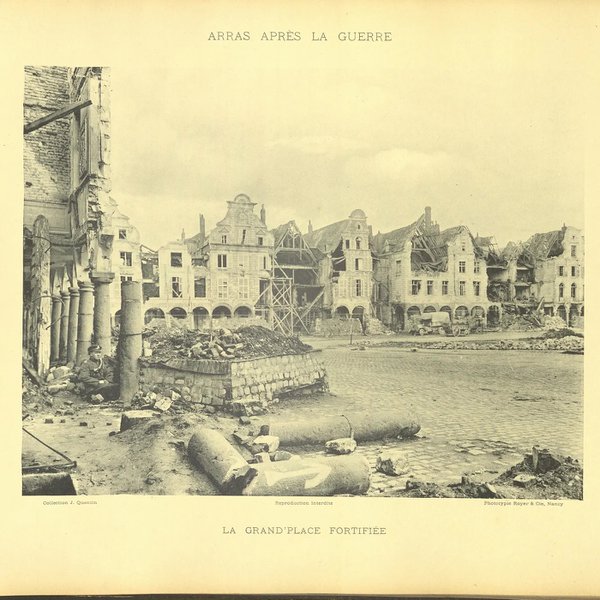 Arras Apres La Guerre, La Grand’Place Fortifee. Ref: DX1101–1 Page 39. From a photograph album presented to the delegation from Newcastle Corporation on their visit to Arras, France, 1923.
As I had listened to the sound recordings of men from the past, I had found them full of emotion. Anger, sadness even boredom; it is all in the sound recordings.
And yet…
Archive description conventions discourage the archivists from describing this in their summaries of the recording.
Here are just two examples.
Barry Nelson was recorded in 1992. The information in the catalogue tells us that Barry Nelson talks about his childhood in Byker, Newcastle upon Tyne, in the late 1960s and 1970s: childhood friendship groups and pastimes, school education, closeness and insularity of local community, shops, experience of urban regeneration, moving from terraced housing into new housing, loss of community, resentment of change, visits from architects, incoming population from Walker and Heaton, friction between gangs of teens from Walker and Byker.
But when I listen to the recording my description would be: Little Barry Nelson was filled with worry when his family was split up. Their street was being demolished to make way for the Byker wall, and Barry’s beloved Granny Nelson was to move to a totally different part of Byker. The grown-up Barry’s voice is filled with anxiety as he recalls leaving his friends and grandparents. This is not just resentment of change; this is fear, anger, anxiety, sadness and eventually acceptance.
George Gray was recorded in 1982. The information in the catalogue tells us: George Gray Born 1886. Recording Location: unknown. Recording Duration: 5 hr. 31 min. The structure of the reminiscences is largely chronological, recorded over a period of approximately two months, although not all segments are dated. From internal evidence, the reminiscences were recorded at the behest of Gray’s family, particularly ‘Our Tom’, George Gray’s son. There is evidence of self-editing through breaks and over-recording, for example at the end of UTWAM0010/1 S1 when an additional remark is recorded over a longer piece of speech.
My description would be: George Gray was born in 1886. George lived an incredible life mostly in and around South Shields. He joined the army in 1914, lying about his age in order to sign up and fight in the First World War. An 18 year old boy when he joined, by the age of 19 he was leading a group of soldiers. Aged 86, George vividly recalls the horror of being bombed and finding his friend dead from a shrapnel wound to the chest. The bombing causes George to experience post traumatic stress disorder, that he calls shell shock. He constantly relived his terror, as he shook and shook and repeatedly told himself to ‘Pull yourself together. Pull yourself together.’ Eventually he recalls his hysterical laughter when he receives a letter from his Auntie Isobel at Windy Nook, saying she is relieved to hear he is out of the shells. The listener can hear the power of his emotions 67 years after the event.
We are often told that traditionally men don’t express their feelings. The recordings from the past tell us something very different. Both Barry and George fill their recollections with emotion. Their voices modulate, their speech falters. They are not men who are trying to maintain some mythical stiff upper lip.
The archivist and the artist are both battling with their reaction to the emotions in the collection. One is fighting to keep their emotions out of their work, the other is fighting to put their emotions in.
It is this emotional gap that intrigues me.
Richard Bliss
Richard is an artist and tailor. This was written as part of his artist residency at Tyne and Wear Archives, as part of the ‘Unlocking Our Sound Heritage’ project; a UK-wide project which aims to preserve, digitise and provide public access to a large part of the nation’s sound heritage.