
Petit Bras
Petit Bras by Julia Collar
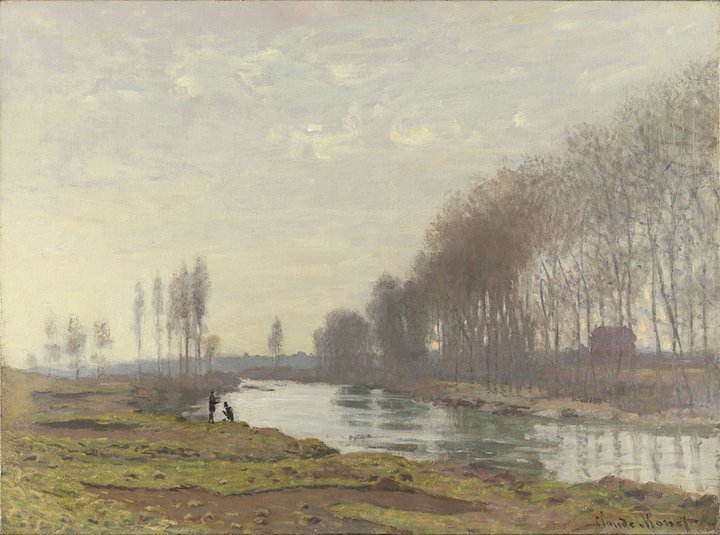
Claude Monet (1840- 1926), The Petit Bras of the Seine at Argenteuil, 1872, Oil on canvas © The National Gallery, London
Hello. My name is Leslie, and I'm going to take you on a journey back in time. We're travelling back to the late 1800s, to a small French village on the River Seine, a place straight out of a painting by Claude Monet where people visited for family outings, boating trips, and strolls along the river.
To make your journey more fun, I would like you to help me bring a poem about this painting to life, by joining in, by creating sounds, noises, and actions. Don't worry, you can do as little or as much as you like, and if you prefer, you can just sit comfortably and listen.
You will need to gather the following items to take with you on your journey. Don't worry if you don't have everything; you can still use your hands, voices, and feet to make lots of noise, and there is plenty for you to join in with.
Right. Are you ready for your list?
You can write them down and then stop this recording while you and your grown-ups go and find them. It's a good idea to keep all your props close by.
OK. You will need:
- A plastic or metal bowl filled halfway with water
- A torch
- Some tin foil, tissue paper, or plastic food packaging
- Ice cubes
- A tray or plate with a wet tea towel, and/or wet paper leaves (instructions for how to make these are in the create your own sensory props and environments section)
- A mug
- Twigs, popsicle sticks, Lego, or a book or magazine; or you can make a “Creak Machine”. You will need: an empty Pringles, cocoa, or other similar container, and something to pierce the bottom; a button, some string, a wooden spoon, and some oil (instructions on how to make this are in the create your own sensory props and environments section)
- A handful of cut strips of plastic bags, tinfoil, or plastic food packaging.
Hello again. Are your props in front of you? Your grown-up can help with handing you things and joining in. Please make sure an adult is present with you when creating the sensory experiences for health and safety.
I love to tell poems that are packed with sensory activities to help you bring it to life. So, let's get started.
Our poem takes place in winter on the banks of the River Seine, where two people are enjoying the beauty of the landscape.
(introduction: river water sound)
Drift, hush-
light pools, flows,
silver slipping,
the river slows.
It’s your turn now to recreate the sound of the river flowing. Gently swirl your hands and or fingers around the inside of the bowl of water. You can try doing it slowly and then fast. Watch how the water ripples and swirls and listen to its splashing. Try shining a light from your phone or a flashlight onto the water to see if you can make it reflect in the light.
(flowing and running river water sounds using a bowl with water)
Winter glistens,
scratches face,
cool, chill sparkles
in tranquil space.
Let's make the sounds of winter. Take your tin foil, tissue paper, or plastic packaging and scrunch it and open it over and over again to make the chilly, icy, sounds of winter. Do it quickly and slowly to hear the differences in sound. If you have ice cubes, you can drop them into your bowl of water to hear the melting crackly sounds they make. Swish them together with your fingers to experience the icy cold river.
(Crunching sounds using tinfoil)
Mud dapples' banks,
cool, thick, low,
feet press,
voices murmur slow.
It's time to stroll along the riverbank. Walk or tap your hands over the wet tea towel to create the squelching of muddy footsteps. Try squeezing the towel for a squishy sound! You could also try using wet paper leaves. Which makes the best sound?
(squelching mud sounds using wet tea towel)
We don’t want to disturb other people enjoying themselves, so we need to speak softly. Cup your hands over your mouth or you can use a mug and whisper any words or sounds you like to your adult to create hushed speaking.
(muffled voices using a mug)
Boughs bend,
lean, creak, sigh,
fingertips reach
toward arched mauve sky.
Have you ever heard trees bending and creaking? Let's make the sound of the poplar trees bending using your very own creak machine, or by snapping some twigs or popsicle sticks, or flapping a thick, soft cover book or magazine, or by moving some Lego together in a plastic container. Can you think of any other objects in your home that you can use to make the sound of the trees moving?
(Creaking trees using Pringle creak machine)
Clouds stretch,
pale light high,
water lingers,
overcast day slips by.
Take hold of your strips of foil, plastic, or food packaging and wave them all together in the air gently to make the calming atmospheric sounds of this beautiful winter scenery.
(whooshing sounds using tinsel)
Now I am going to read the poem without any of the Foley sounds. Try closing your eyes while you listen and focus on the sounds the words make, the images that come to mind and how it makes you feel.
Drift, hush-
light pools, flows,
silver slipping,
the river slows.
Winter glistens,
scratches face,
cool, chill sparkles
in tranquil space.
Mud dapples' banks,
cool, thick, low
feet press,
voices murmur slow.
Boughs bends,
lean, creak, sigh,
fingertips reach
toward arched mauve sky.
Clouds stretch,
pale light high,
water lingers,
overcast day slips by.
(sound of a running river )
If you want to listen to these Foley sounds, and other noises you might hear in this landscape, you can find them in the Sounds section of Sensory Journeys.