
Looking with Nature: Self-guided Ecological Tour of the Collection
This self-guided tour invites you to uncover ecological themes and issues in the Laing’s collection displays.
Introduction
The tour has been developed by a group of Newcastle University staff and students, led by Dr Olga Smith. Brought together by a passion for environmental justice and a concern for nature, they created this resource to highlight some of the works in the collection. Placed in relation to major present-day concerns, works from a distant past gain new meanings and significance.
The tour also gives an insight into the industrial history of Newcastle upon Tyne, and its environmental implications.
The Margaret and Winneford Bowl, about 1767
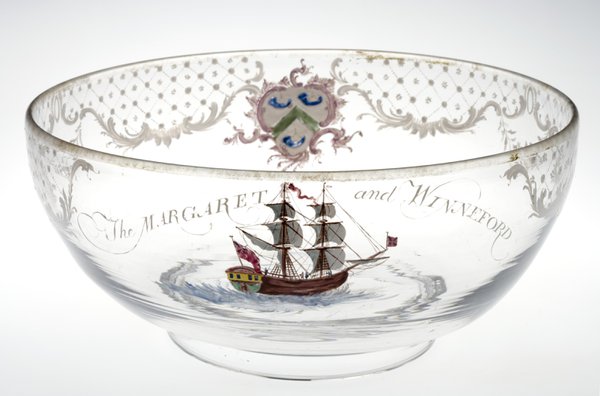
Glass with painted and enamel decoration attributed to William Beilby
This punch bowl commemorated the launch of a new trading ship for the Forster Family. The two-masted sailing vessel seems to sail inside the bowl under the family crest. This object highlights the links between glassmaking and shipbuilding industries in Newcastle.
In 1767, when this bowl was made, Newcastle was a major centre of glass manufacture. 100 years earlier, burning wood for glass furnaces was banned, to preserve wood for shipbuilding. England’s colonial expansion required many ships to move people and goods. After the ban, Newcastle, which had plenty of coal, quickly emerged as the centre of glass-making. The industry evolved in response to changes, such as the introduction of a glass tax in 1645. Manufacturers responded by making lighter glassware, which was particularly suitable for decoration. The bowl is a fine example of such innovation.
The River Tyne was essential for the industry. Sand, the raw material for glass, came in on boats. The high-quality clear glass used to make this bowl was made from sand extracted in King’s Lynn in Norfolk. Glassware, once made and decorated, was shipped out to be sold, particularly in London and Northern Europe. In the history of this object, our local past intersects with global histories of trade and colonisation, to make visible connections between extraction of materials, industry, and naval dominance.
Nancy Daykin
William Daniell, View of Newcastle, taken from a windmill to the eastward of St. Ann’s, about 1802-3
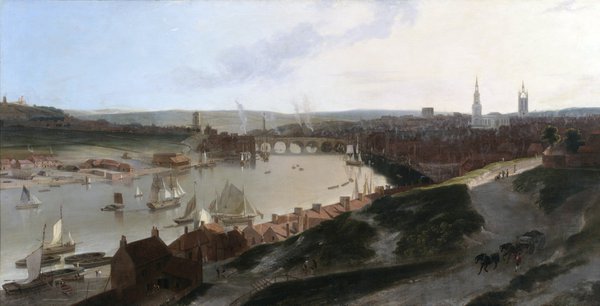
A panoramic view over Newcastle looking west along a busy River Tyne, taken from St Anne’s, an area which, at the time, was largely rural. The painting shows burgeoning trade and industries growing up along the River as the pace of industrialisation accelerates into the nineteenth century. There is evidence of early shipbuilding in what is now the centre of Newcastle, with two ships under construction. Alongside various chimneys spouting fumes, the shot tower from Elswick Lead Works can be seen in the centre-far distance. This was one of the earliest, and most polluting, of Newcastle’s industries. The heavily reliance on the extraction of resources, especially coal, can be seen through the number of keel boats depicted in the scene. These flat-bottomed wooden boats were used to transport coal from the shallow banks of the Tyne to larger seagoing vessels waiting in deeper water. The Keelmen’s Hospital, which housed sick and aged keelmen, would also have been built by this time. Workers’ housing is also shown in the foreground of the scene. The clay roof tiles of the buildings tell us that at this time materials would been sourced locally, this being prior to the city’s first railway in 1839. All Saints Church, and beyond, the Newcastle Cathedral are depicted in white, providing a visual contrast to the dirty, polluting industries that were transforming the city.
Julia Heslop
Edwin Landseer, The Otter Speared, 1844
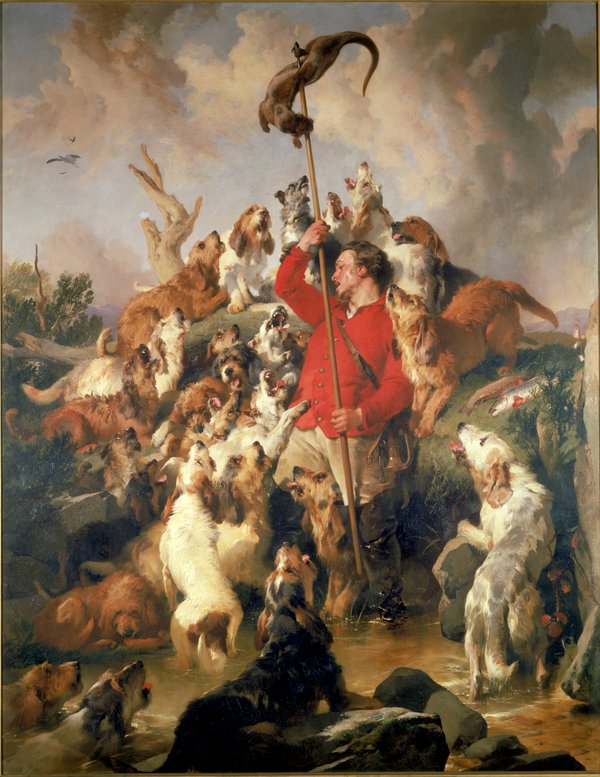
In the Victorian era, otters were classified as destructive vermin and violently hunted. While the huntsman is clearly an image of triumph, the otter is not depicted as a pest but as a worthy and brave opponent, its last act of defiance is to twist its body to bite down on the spear. It was common for Landseer to use anthropomorphism to endow the animals in his paintings with recognisably human emotions and behaviours. As described by Scottish philosopher David Hume (1711-1776), anthropomorphism has been used to explain the ‘unfamiliar and mysterious world we live in by using the model that humans know best, themselves’. By giving the human qualities to animals, Landseer makes us feel empathy for the suffering otter.
Otter hunting in England continued into the twentieth century, however, the use of spears in hunting was abolished in 1884.
Katie Doliver
John Martin, The Destruction of Sodom and Gomorrah, 1852
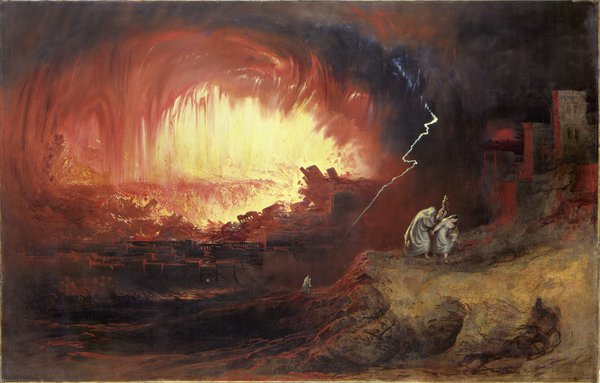
Lot and his daughters flee a scene of catastrophic destruction: bright streaks of yellow and red engulf this Biblical landscape in an act of divine retribution. The British romantic artist John Martin was famous for large-scale paintings that portrayed apocalyptic stories from ancient history and the Bible. Martin was also an amateur engineer who produced plans for embanking the Thames River, linking the major train stations in London, and other forms of modern infrastructure. He even designed his own version of a safety lamp that could be used in coal mines.
Martin was born in Haydon Bridge, which was close to several mines, and he apprenticed in Newcastle. Paintings like this can be interpreted as a warning to his contemporaries about the devastating consequences of modern life and its coal-powered technologies. Although the destruction of Sodom and Gomorrah is a parable about the cost of immorality, Martin’s painting also resembles the famous and tragic mining explosions around Newcastle that gained national attention in the mid-nineteenth century. For both historical and present-day viewers, it is a reminder of the very real human cost of industrial resource extraction.
Stephanie O’Rourke (University of St Andrews)
William Holman Hunt, Isabella and the Pot of Basil, 1867
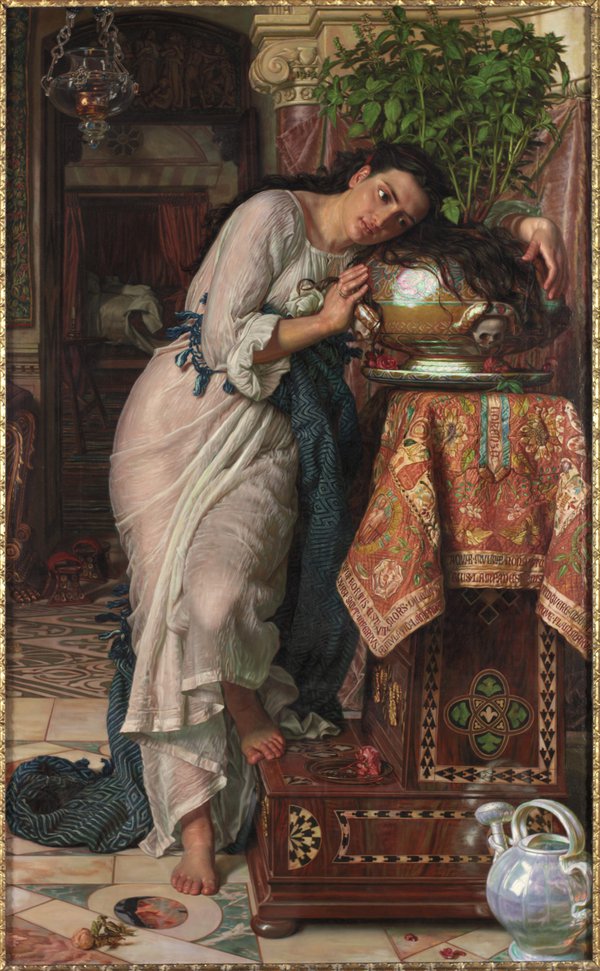
A pot of basil grows ‘thick, green and beautiful’, watered by the tears of Isabella. She clings to the pot, which contains the head of her murdered lover, Lorenzo. His flesh fertilises the soil, aiding the growth of the plant, while the herbal, ‘balmy’ scent soothes her and disguises the smell of decay. Historically, basil has been used in the production of royal perfumes and traditional medicines. The ancient Egyptians even used basil in the embalming process, believing it would open the gates of heaven. Typically imported from India and Africa, the plant can thrive year-round in temperate climates, but its growth is short-lived when affected by severe weather conditions exacerbated by climate change.
John Keats, whose 1818 poem inspired this painting, describes Isabella's brothers, the murderers, as being exploitative of people and natural resources. The pot of basil represents the trade of plants for aesthetic and medical use in gardens (informed by his apothecary training) and Isabella's attachment to it symbolises the fight against her brothers and their wasteful ways.
Charlotte White
Ralph Hedley, Geordie Ha'ad the Bairn, 1881
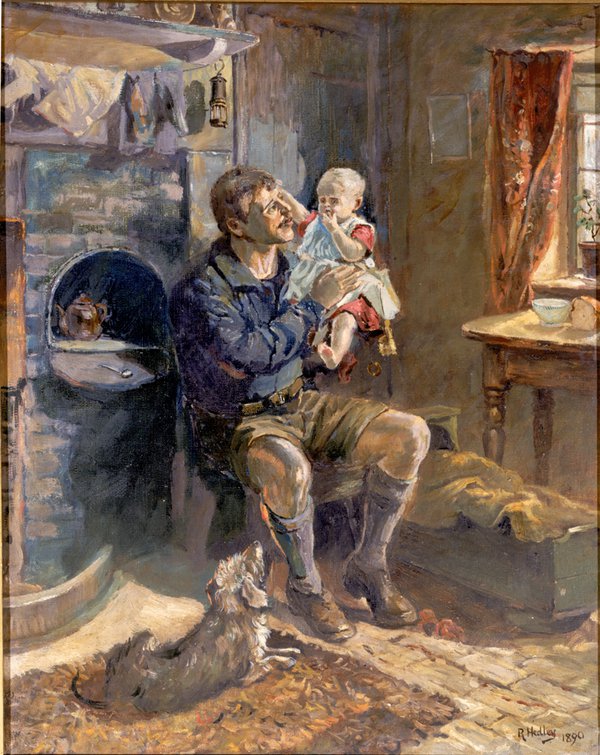
Any day a pit disaster could steal a coal-miner from his family. In this miner’s cottage, a weary father tries to hold his child close. Coal, his livelihood, looms physically in the fireplace behind Geordie. Compared to the dark-clothed miner, his baby is clean and lit brightly by the window. Hedley shows us that innocent ‘bairns’ are born into an environment increasingly polluted by humans. Today a similar anxiety persists, as many feel concerned about what threatens to disappear from nature and its ecosystems in future generations’ lives.
The song that inspired Hedley’s painting has now entered the North East folk tradition. Pitmen from Tommy Armstrong (1848–1920) to Johnny Handle (1935–present) have written and passed down mining songs to the next generations. Comical, documentary, or fiercely protesting, communal songs helped to make bearable the grim conditions of mining. Like Hedley’s realistic depictions of north-east everyday scenes, the songs aimed not to distract from the day-to-day, but to tell stories.
Teddy Cuthbert
Ralph Hedley, Blinking in the Sun, 1881
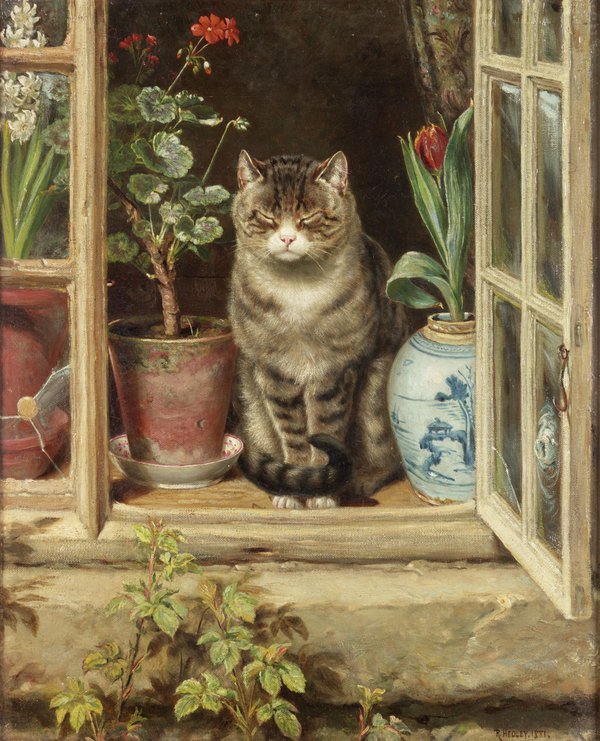
What did you notice when you looked at this painting? The sleepy cat seems to demand our attention. However, the flowers that flank the cat would have once been the centre of attention as fashionable and rare objects. Painted in Newcastle in 1881 by local artist Ralph Hedley this painting holds a story of global plant connections.
Ancestors of the white scented hyacinth on the left and the red tulip on the right can both found growing wild in East Mediterranean countries including Turkey, Syria and Palestine. They only arrived here in the sixteenth century via trade routes and were highly valued. The red geranium to the left of the cat has been bred from wild relatives in South Africa. Its predecessors arrived via Dutch spice ships in the eighteenth century. The rose reaching up the wall towards the window is most likely descended from roses bred over thousands of years in China, again arriving via trade routes. Even the cat can be traced to Africa, brought here from Egypt by the Romans.
All the living things in this painting have their own global stories of Empire and colonialism.
How many of the familiar plants and animals you have walked past to get here today are also global travellers?
Clare Hickman
Isa Thompson, Fisher Folk, 1893
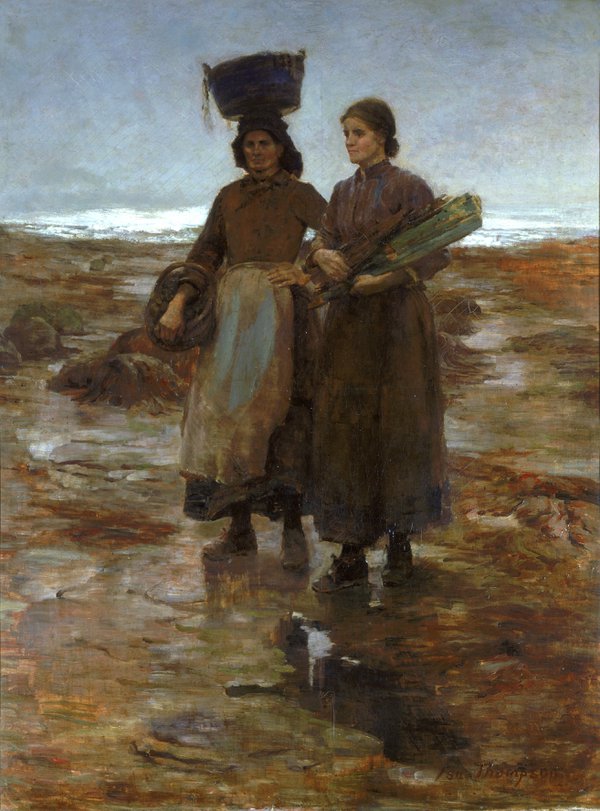
The women in this painting collect seaweed and driftwood left behind by the tide. The colours of their clothing mirror the surrounding landscape, showing their close relationship with the natural world.
This kind of foraging was essential to coastal life. Seaweed was used for fuel, fertiliser and dyes, while driftwood was reused because timber was limited along the coast. This work was often carried out by women while men fished at sea. It depended on close knowledge of tides and seasons, yet it was rarely recorded or valued in the same way as other kinds of work.
Isa Thompson painted scenes like this in the late nineteenth century. Born in Newcastle, she trained at the Newcastle School of Design and later in Paris. She worked in Cullercoats and Staithes, creating artworks inspired by the local people’s close connection to the sea. Today, questions about sustainability and the use of natural resources are becoming more urgent. The painting offers another way of imagining our relationship with the environment, one based on living within the limits of our environment rather than exceeding them.
Isobel Harbinson
Paul Gauguin, The Breton Shepherdess, 1886
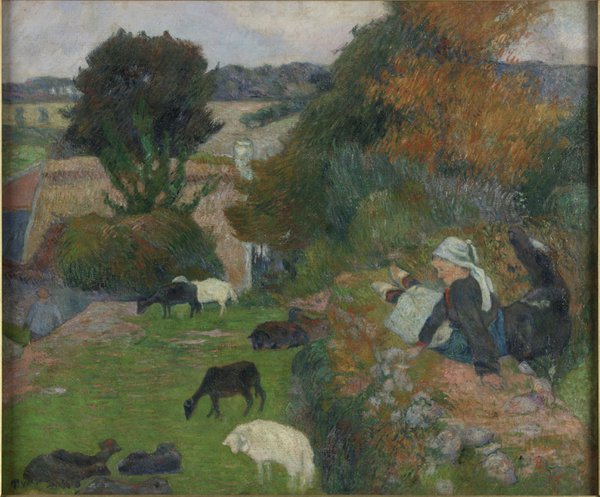
Paul Gauguin painted this work during his early stays in Pont-Aven in Brittany. During this period the artist began to transition towards a more flattened perspective and expressive colours. This new aesthetic would come to define his signature style and establish a new direction in nineteenth century painting. Significantly, this important development occurred within the rustic context of Breton countryside, at a time when the artist could work immersed in nature.
Like Gauguin, the shepherdess in the painting seems to become absorbed into the surrounding landscape. She sits atop a stone-faced earth bank (the typical Breton ‘talus’), but does not seem to be elevated or given more prominence in the composition than the grazing sheep. The eye travels, without stopping, across the surface of the painting, taking in the shepherdess, the sheep, the verdant field, and shimmering effect of sunlight filtering through foliage.
Flattened, in this manner, against the picture plane, all elements of the picture gain equal weight and significance. This vision corresponds to the foundational premise of ecology that all life on Earth is interconnected, as established by Charles Darwin in his theory of evolution. The shepherdess is not separate from the surrounding nature, but is a part of it. We, humans, co-exist with other forms of life on the planet that we all share in common.
Olga Smith
Norman Cornish, Pit Road, about 1960
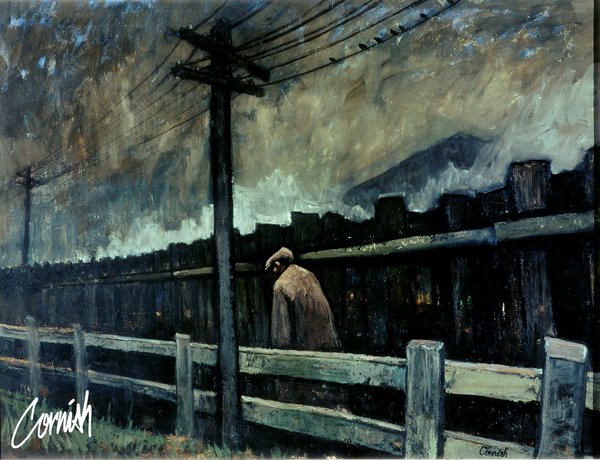
The tired miner walking the pit road could be a self-portrait. Cornish began to work in the mines of the Dean and Chapter colliery in County Durham at the age of fourteen in 1933. After almost thirty years of working there, he left following the closure of the colliery. It was one out of 127 pits that closed between 1963 and 1995 in the Northeast due to total resource exhaustion. Only four years after this closure, Cornish himself would reluctantly retire because of worsening back problems. Many of his colleagues would also see their health suffer from injuries, accidents and often fatal diseases, such as pneumoconiosis, caused by breathing in dust particles. In the painting, just above the hunched figure rises a pit heap: a mound of accumulated waste resulting mining process. Closely linked compositionally, the pit and the miner ask us to consider the cost of extraction – to ecological systems and humans both.
Niamh Mackintosh
Image reproduced by kind permission of the Norman Cornish Estate.